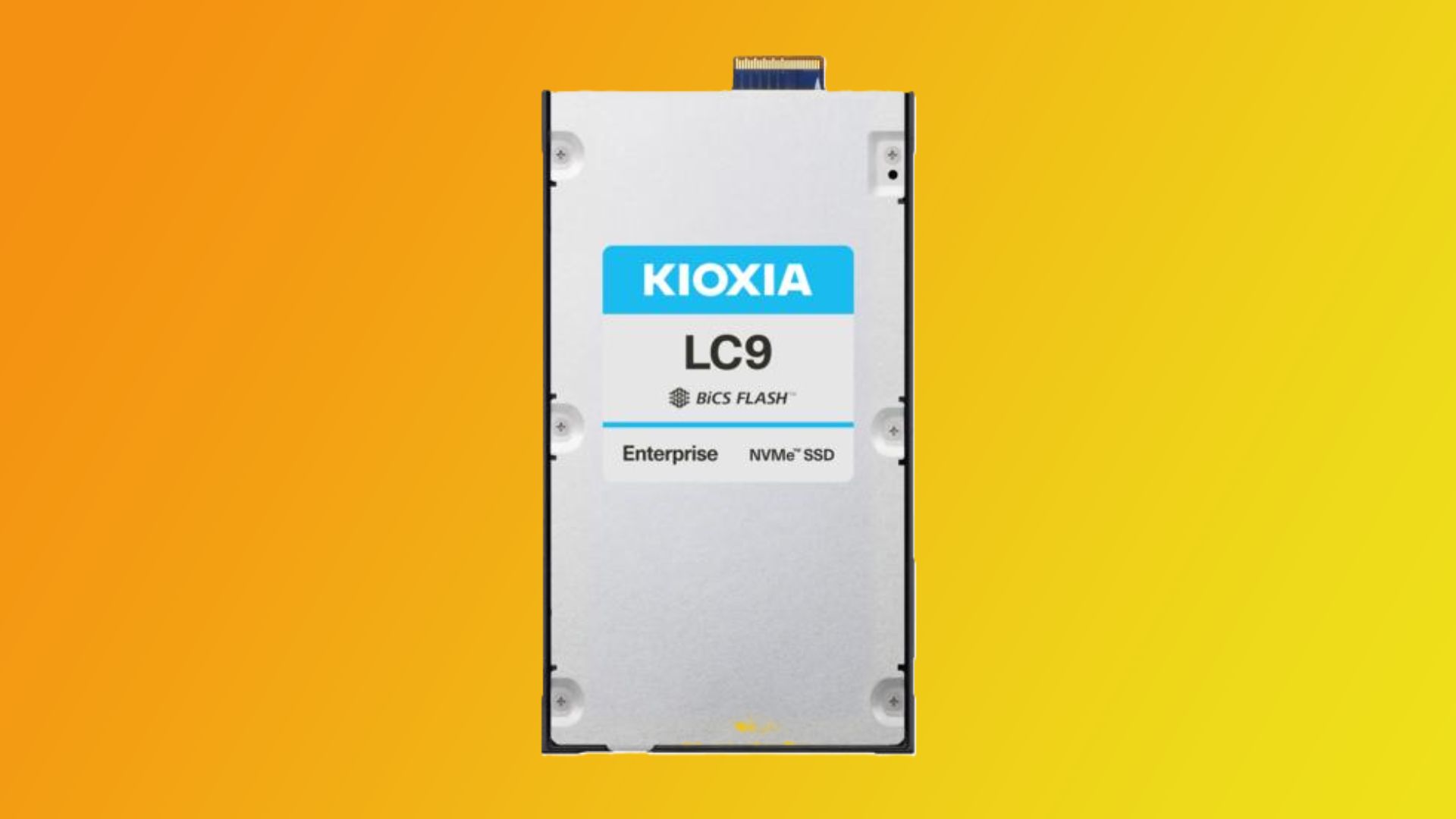
There’s a golden rule of storage: no matter how much you have, it’s never quite enough. Nevertheless, Kioxia is taking that principle to its limits, as it’s announced “a new storage density milestone” in the form of 640 of its 245.76 TB enterprise SSDs chained together to create just over 157 petabytes worth of storage in a single rack cabinet.
157 petabytes is… well, it’s 157 million gigabytes. Enough storage space for God of War: Ragnarok, a 190 GB game, to be installed over 820,000 times.
And yes, it’s been designed for AI data centers. The “storage solution” (I do hate that term) has been created in collaboration with Dell, and essentially amounts to 16 PowerEdge R7725xd servers, each stuffed with 40 Kioxia LC9 Series drives inside one industry-standard 42U server rack.
“As AI workloads drive continued growth in unstructured data, organizations need storage that can deliver higher capacity without a corresponding increase in data center floor/rack space, power consumption or cooling requirements,” says the press gumph. “High-capacity NVMe SSDs can help address these demands by consolidating more data into a smaller, more efficient infrastructure footprint.”
Which seems timely. With physical data center size becoming an increasing issue (not least because massive data center buildouts are a tad unpopular right now), cramming as much storage as possible into a single rack is sure to save on some concrete, at the very least.
But I’m not going to suggest this sort of excessive consumption is anything but jarring, given us little ol’ consumers are counting our pennies in the middle of a NAND flash crisis. Have you seen the price of game-ready SSDs recently? I have. It ain’t pretty.
But hey, at least we know where 157 petabytes-worth of raw flash capacity is going. Straight into one of these rack cabinets, where it can be used for all sorts of AI-related purposes. The sometimes-intelligent beast needs feeding, and Kioxia and Dell appear to have worked very hard to fit its lunch inside one handy box.