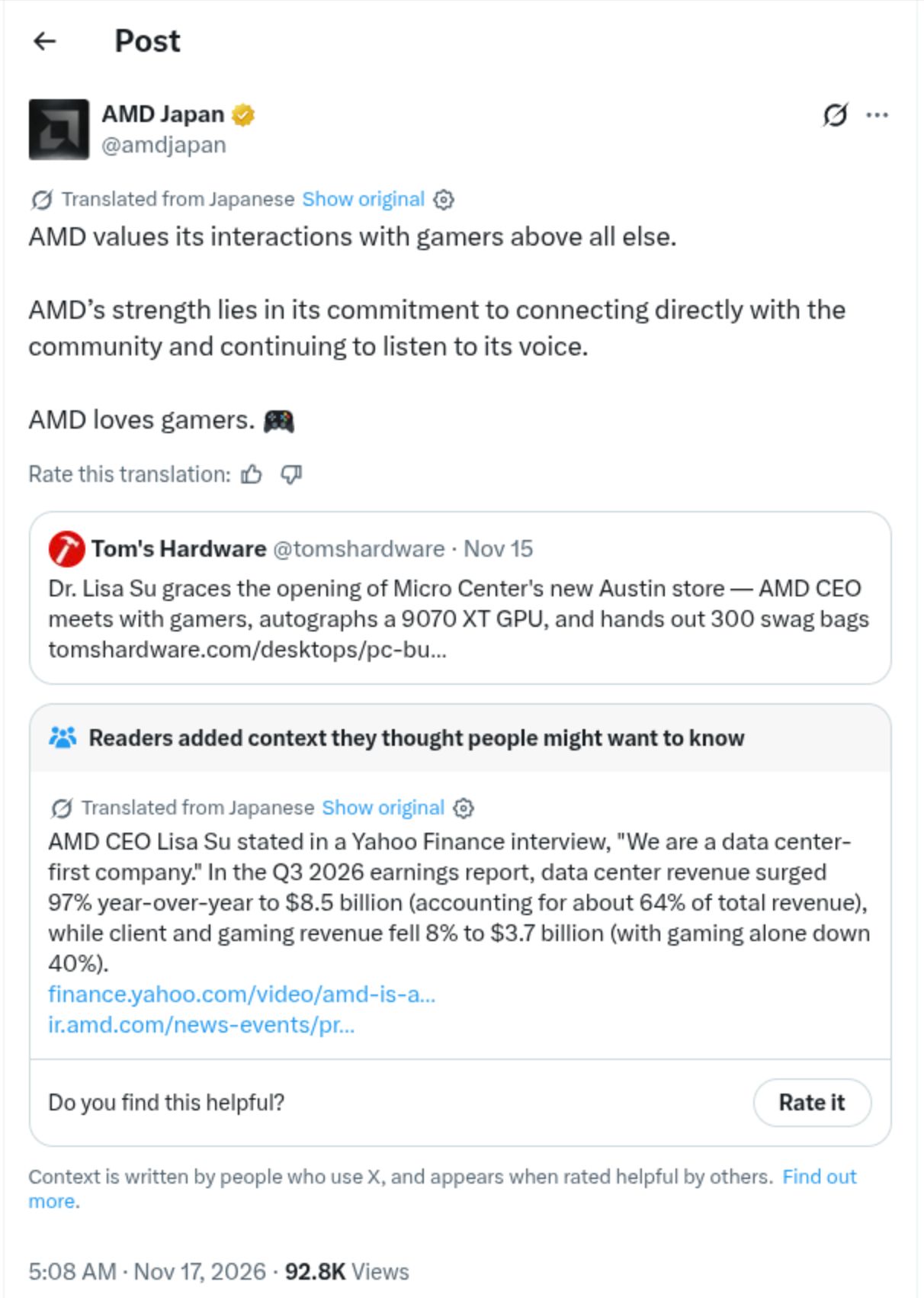
AMD landed itself in hot water with gamers a couple of weeks back by saying the quiet part out loud: CEO Dr. Lisa Su announced that it was a “datacentre-first company” in a call with investors, who were likely to want to hear that sorta thing. Yet upon reaching gamers’ ears, the news wasn’t so well received.
Now, AMD Japan has tried to settle things down by proclaiming “AMD loves gamers.”
To be fair, those two statements aren’t mutually exclusive. AMD can be datacentre first, and absolutely is, and still claim to care about gaming. Though when supply for key components is tight and prices are rising, we’re definitely looking for a little more than kind words at this time.
What makes matters worse is that AMD Japan also added: “AMD values its interactions with gamers above all else.”
Now, that’s a much tougher sell.
In Q3, AMD made more than double the cash from its datacentre segment ($8.5 billion) than its client and gaming segment ($3.7 billion)—the latter includes various Ryzen, as well as Radeon, products. Pure gaming revenue was a mere $773 million, and dropping fast, whereas datacentre revenue was up 97%.
So, from a purely business perspective, AMD is undoubtedly all in on datacentres. I don’t like to admit it, but it makes sense for a company owned by shareholders to go after the biggest growth market. But all the more reason not to claim an undying love for gamers—it just doesn’t pass muster.
AMD Japan is responding to a tweet from our sister site, Tom’s Hardware, who had reported that the company’s CEO had attended a store opening for a new Micro Center in Austin, Texas and was handing out autographed graphics cards and swag bags to lucky attendees. So, in that sense, AMD can claim to have helped a handful of gamers directly. An RX 9070 XT signed by Lisa Su may hold its value more than one signed by Jensen Huang.
Nevertheless, the post on X hasn’t been too well received. A reader note has been added to note AMD’s claim to be a datacentre first company, and the replies are a bit of a dumpster fire.
Truth be told, it’s not a good time to claim to care about the gamers, whether there’s any truth to the claim or not. From graphics cards to SSDs, we’re stuck with extremely high prices, beyond most reasonable budgets, and few exciting product launches to note—except monitors. Thank God for monitors.