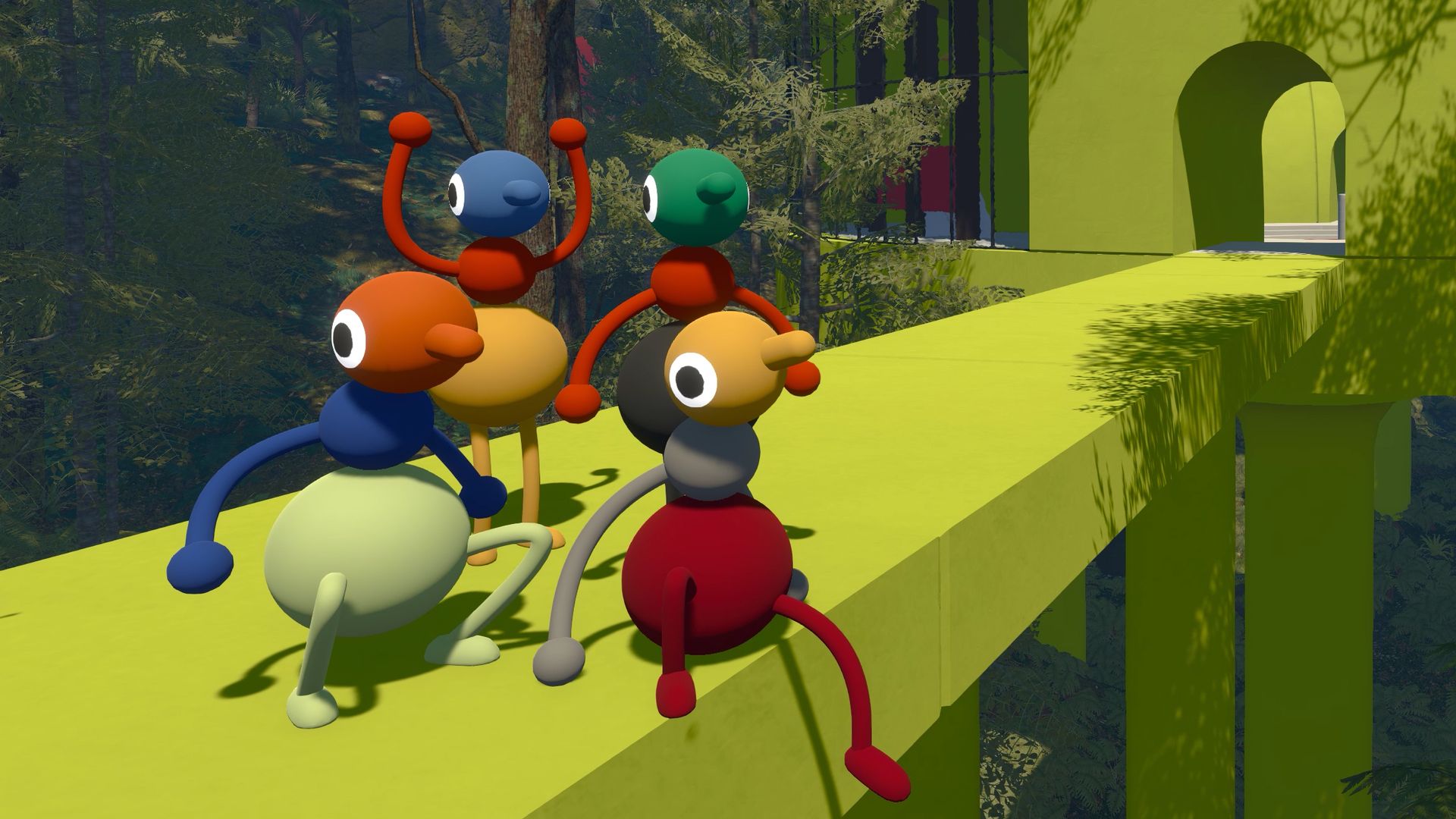
Big Walk developer House House has sparked a brand-new generative AI debate after revealing that it had utilised LLMs “sparingly” during the final stretch of the game’s development.
The revelation came in the hours following a statement from a handful of jurors participating in the Independent Games Festival awards. In the statement, it called out the “significant increase in the number of submitted games developed with generative AI tools,” adding that it had “set off some fairly intense discussion and disagreement across the judge and jury pools.”
The statement specifically called out AI-generated code, saying it was “not an exception,” adding: “Programming is a creative discipline whose labour deserves the same respect we extend to any part of making a game. This extends to the past work used to train these models without the creators’ consent.”
While no game was specifically called out, as Aftermath reports, it didn’t take long for word to spread that one particular title had caused so much of the debate: Big Walk, and the recent discovery that it had made use of generative AI during development.
House House’s cooperative puzzler has been a huge hitter this year, striking a chord with many (myself included) and standing as a strong contender in what has been a relatively quiet year for videogames.
It’s also developed by a team that is no stranger to taking strong stances, as evidenced by its decision to keep the game off Xbox consoles to support the pro-Palestinian Boycott, Divestment, and Sanctions movement. Which makes it even more surprising, to some, that House House opted to utilise generative AI.
In the wake of the news, the developer has tacked on an AI statement to the Big Walk website’s FAQ. “In the final stretch of Big Walk’s development, LLMs were used sparingly by House House to help work through difficult technical challenges and bugs,” it reads. “In some cases, snippets from LLM responses were copied as a starting point to be modified into game code—we’d estimate that well under 0.1% of Big Walk’s code had anything to do with this usage, and generative AI was not used in any other context when making the game.”
The statement offers an example of how this was put into practice—in this case, “about 10 lines of code” used to fix a problem that House House was apparently unable to rectify manually or by speaking directly to a Unity engineer.
As for why there was no AI disclosure on Steam? Well, as House House points out, the platform “does not request disclosure of code or chatbot usage,” adding: “We are posting this disclosure as it has become a matter of public interest.”
House House says that its statement “is not an endorsement of, or argument for, the use of AI tools, however minimal,” before closing with: “Big Walk was developed without an internal AI usage policy in place, and we consider that lack of policy a failure. We will work to have a more comprehensive policy going forward.”