**Welcome to Burning Springs: A Tour of Ohio’s Apocalyptic Landscape**
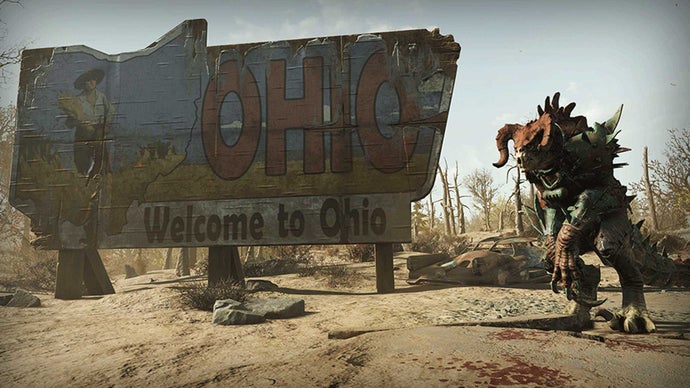
Greetings, traveler, and welcome to Burning Springs! You may know it as the latest location in the newly updated **[Fallout 76](https://www.rockpapershotgun.com/games/fallout-76)**, but to me, a recently defrosted Ohioan historian from the ancient past of 2025, it’s home.
Our tour will commence shortly, but first, allow me a moment to gather my thoughts. It appears Fort Steuben has mysteriously relocated from the memory of my frozen past, nearly 120 miles from here. Geography has certainly changed since my slumber, but let’s delve into that peculiar distortion later.
**Ohio: More Than a Meme**
To much of the world, Ohio may be perceived as a mere meme, a flyover state notable mainly for subpar presidents. However, to us Ohioans, it is proudly referred to as “the heart of it all.” Once the starting point of the American frontier, in 2025, we were the Midwest’s epitome of innovation, laying claim to both **[the birthplace of aviation](https://visitnaha.com/birthplace-of-aviation/)** and the culinary oddity of **[chili on spaghetti](https://en.wikipedia.org/wiki/Cincinnati_chili)**.
Now, you might be curious about the 109 concrete corn cobs.
**A Look at the World of Corn**
We begin our tour at what is known as the World of Corn—formerly the **[Field of Corn](https://www.visitdublinohio.com/listing/field-of-corn-(with-osage-oranges)/451/)**. Established in 1994, this public art installation in Dublin, Ohio features 109 concrete ears of corn, honoring Sam Frantz’s contributions to hybrid corn varieties. While I don’t recall a corn-shaped robot roaming the park during my days, it seems this little guy is well-versed in the corn business, ready to share fun facts with visitors.
Notably, the Field of Corn used to be located much farther north, but the distortion of geography is a subject we’ll revisit later.
**Exploring the Remnants of Hocking Hills State Park**
As we progress, our journey leads us through some of the least irradiated portions of Appalachian Ohio, wedged between Gallipolis and an unsettling mini-golf course infested by deathclaw nests. Adjusting to Ohio’s current desert-like atmosphere has been a challenge for me; once rolling with lush greenery and cicada-filled air, it’s now tinted with rust-colored sands and remnants of **Abraxodyne Chemical Corporation’s** toxic legacy.
Our next destination is the celebrated **Hocking Hills State Park**. Historically renowned as Ohio’s scenic haven, it offered picturesque trails through hemlock gorges and caves, all carved into ancient Blackhand sandstone. Though denuded of its former flora, the park offers hauntingly beautiful rock formations that still resonate with the echoes of geological history.
As you explore these sights, be wary of raider activity—clearing them out may yield useful treasures for your time here.
**The Reimagining of Athens**
Next, we venture into Athens—not the famed city of Greece, but Ohio’s own historical hub. In my time, Athens was an academic stronghold with Ohio University, the Northwest Territory’s first institution. Fast forward to 2105, and we see changes in the educational landscape with Hocking Hill University retaining elements of its predecessor, albeit with some peculiar branding alterations.
You’ll notice the Athens Armory, wrapping eight decades as a community centerpiece, still standing strong despite the apocalyptic changes around it.
Strangely, Fort Steuben has now made a home in Athens, though its historical counterpart once established itself in Steubenville, far away. The irony is not lost on me, as the history of Fort Gower—a key point in early American conflict—seems to fade amidst a new bandit encampment overshadowed by a whimsical windmill.
**Echoes of a Forgotten Past**
Our exploration leads us to the Hartman Mound, which once represented part of the **[Wolf Plains Group](https://en.wikipedia.org/wiki/Wolf_Plains)**—ancient burial mounds that signified a rich spiritual history now lost to time. Sadly, much of this cultural heritage has been bulldozed into obscurity in this changing landscape.
We can’t overlook the derailed freight train in downtown Athens, spilling hazardous substances reminiscent of the **[East Palestine train derailment](https://en.wikipedia.org/wiki/East_Palestine,_Ohio,_train_derailment)** that shocked the nation just a few decades prior. Such disasters embody the negligence associated with Appalachian history, a region long perceived as neglected.
**Highway Town: A Settlement of Resilience**
As we conclude