### FPS Quest: A Tantalizing Exploration of Frame-Rate Metaphor in Gaming
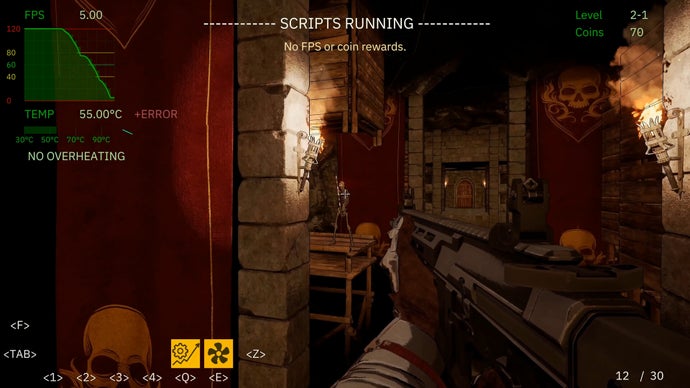
FPS Quest, developed by Farlight Games Industry, presents a unique take on the dungeon crawler genre, introducing a groundbreaking gameplay mechanic where “frame-rate is your health.” This concept marries the performance of the game with the player’s health indicators, compelling players to optimize their gaming experience to avoid damage that results in slowness and stuttering.
In FPS Quest, players must engage with a variety of settings reminiscent of a user struggling with a low-performing PC. This involves adjusting graphics settings, such as lowering texture quality and deleting environmental assets, which can create a disjointed and challenging gaming experience. The intriguing line from the game’s Steam page reads, “optimizing is risky,” hinting at the complex interplay between optimization and gameplay dynamics. Moreover, players will need to manage an in-game simulation of their PC’s temperature, adding another layer of strategy.
The game’s narrative unfolds in a metafictional manner, drawing parallels to titles like *The Stanley Parable* and *Pony Island.* FPS Quest weaves a story around the idea of performance versus experience, prompting philosophical questions regarding authorial intention and player reception. Players assume the role of an avatar installed with a bizarre mod, navigating various factions vying for control. The developers, while monetizing their creation, are opposed by OutofBounds, who aim to simplify gameplay, as well as the Custodians, who advocate for the original developer’s vision while resisting cheats and glitches.
Encounters with unusual AI characters enrich the experience, including the Null Process, a broken AI attempting to impede player progress, and the Dungeon Lord, who embodies an overzealous helper, often complicating rather than simplifying player interactions. The way players engage with these factions and AI is primarily through gameplay rather than traditional dialogue, further enhancing the game’s immersive quality.
FPS Quest also features unlockable mechanics, such as a “dynamic bullet time” the player can control via mouse wheel, allowing for varied gameplay experiences. This opens avenues for philosophical musings: Is an intentional bug still a bug? In a game that’s designed to be perceived as broken, what constitutes an error versus a designed feature? The exploration of authenticity becomes a central theme, questioning whether a game can maintain integrity despite its intended flaws.
However, there is a concern that FPS Quest may not fully embrace its concept. Some elements of the narrative might merely embellish what could be a standard fantasy action experience filled with typical progression mechanics. The developers’ cautious approach is evident in how they treat death in the game—displaying an MS-DOS bluescreen that humorously states, “the game will now close to prevent further humiliation.” This aligns more with a lighthearted style akin to *Borderlands* rather than the profound exploration reminiscent of Roland Barthes’ literary theories.
Additionally, the team’s decision to simulate frame rate drops rather than altering actual performance shows intention to avoid discomfort associated with low FPS gameplay. While this may ensure a more enjoyable experience for players, it may also limit the game’s potential for genuinely pushing players out of their comfort zones—an aspect of gaming that some players find compelling.
FPS Quest promises an intriguing experience that blends technical gameplay with deeper philosophical questions, yet it remains to be seen how far it will push its innovative concept. The game is set to release at an unspecified time, keeping the gaming community excited for its arrival and the unique exploration it offers in the realm of performance and narrative.