**The Convergence of Politics and Popular Culture: The Role of Memes in American Governance**
In today’s realm of American politics, the incorporation of memes and gaming visuals has emerged as a key tactic for captivating audiences, especially among younger age groups. This phenomenon has been vividly illustrated by the current administration’s deployment of popular cultural allusions to express political ideas and changes in policy. A recent example of this trend is the Trump administration’s endorsement of whole milk in school lunches utilizing imagery reminiscent of the cherished farming simulation game, *Stardew Valley*.
On January 14, former President Donald Trump enacted a law reinstating whole milk in school lunches, reversing limits set during the Obama era. While the reintroduction of whole milk might not rank among the most contentious decisions made throughout his presidency, its promotion through gamified content exemplifies a larger movement of political communication designed to resonate with the digitally inclined youth.
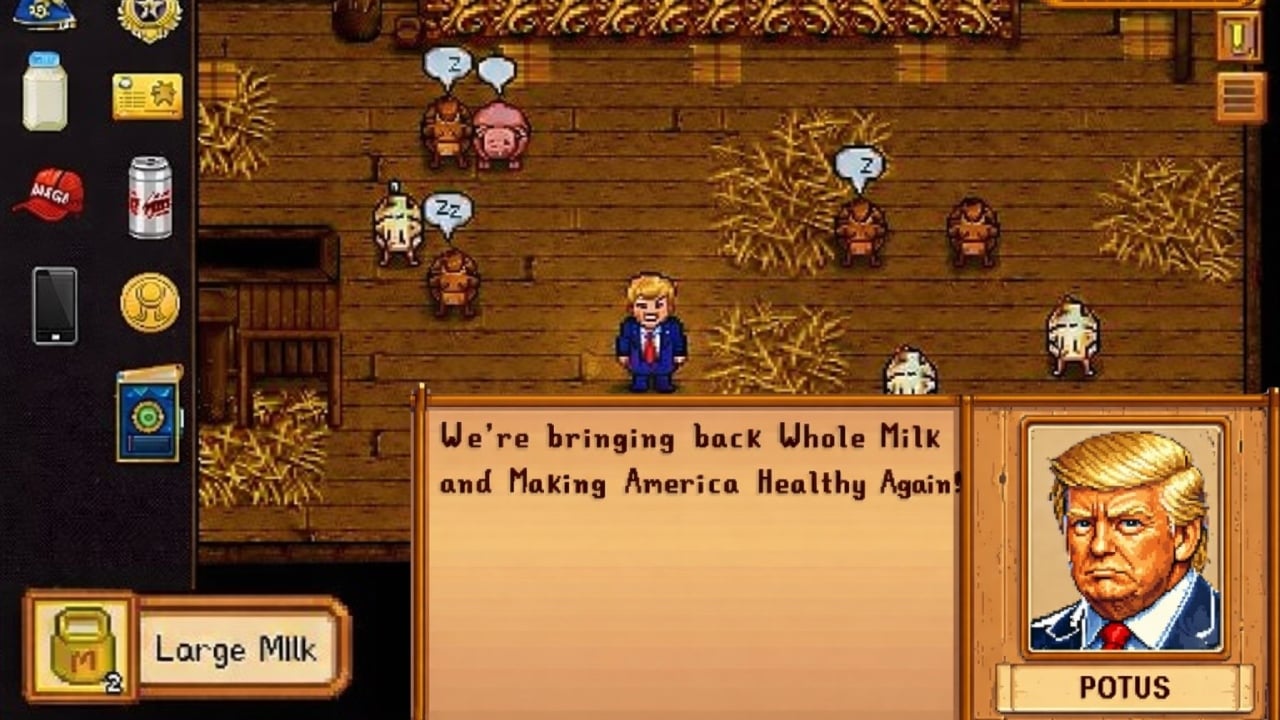
The White House released an AI-generated graphic featuring Trump in a pixel-art aesthetic similar to *Stardew Valley*. The portrayal humorously exaggerates his features, implying a whimsical take on a serious policy issue. Accompanying the image, Trump’s caption states, “We’re bringing back Whole Milk and Making America Healthy Again,” presenting an ironic twist in light of ongoing discussions surrounding school dietary health.
Additionally, the image reveals a noteworthy easter egg—Trump’s inventory shows a number that carries particular significance: 45464748. This sequence references Trump’s identities as the 45th and 47th president, merging his political persona with the visual story being told. The implication is amplified by Trump’s persistent assertions of winning the 2020 presidential race against Joe Biden. His public wish for a potential third term, in spite of the limitations imposed by the 22nd Amendment, introduces another layer of meaning to the meme.
Critics might regard this method as minimizing serious political concerns, trivializing policy decisions through the framework of pop culture. Nonetheless, the strategy connects with a generation that frequently engages through memes and social platforms. By embracing this format, the administration seeks to resonate with young voters who are active online and may be more open to whimsical, meme-driven communications.
In summary, the incorporation of memes and video game elements in political dialogue signifies a noteworthy progression in how political figures connect with their constituents. As the lines between politics and entertainment continue to blur, the effectiveness of such approaches in shaping public sentiment and impacting future generations remains to be seen. This trend underscores not only innovative communication methods in politics but also prompts consideration about the consequences of merging governance with aspects of leisure and entertainment. The evolving interaction between these domains marks a substantial transformation in the landscape of American political communication.