
### The Influence of Deus Ex on Modern Gaming: A Reflection on the 21st Century
In the realm of video games, the emergence of complex systems that allow for emergent action and cascading consequences has become increasingly common. Notably, the ideas presented in the revolutionary title *Deus Ex* have proliferated into mainstream gaming culture, much like a wildfire spreading across a parched landscape. As we navigate through the 21st century, one cannot help but notice the profound impact *Deus Ex* has had on game design, influencing various titles across multiple genres.
#### Emergence of Emergent Gameplay
While some of the similarities found in modern games may be coincidental, it is evident that developers are drawing inspiration intentionally from *Deus Ex*. For instance, Emil Pagliarulo, a significant figure in the gaming industry, has openly acknowledged the influence of *Deus Ex* on his work. His career began at Looking Glass, where he contributed to the critically acclaimed *Thief II: The Metal Age*. Here, he crafted the memorable level “Life of the Party,” which showcased the potential of player agency within a structured environment.
Pagliarulo later joined Bethesda Game Studios, where he took the design philosophies from his formative experiences and infused them into titles like *Oblivion* and *Fallout 3*. He expresses deep admiration for the original *Deus Ex*, stating, “I love the original Deus Ex. It’s a huge influence on me.” His passion for creating immersive experiences that provide players with a variety of choices can be traced back to the freedom and moral complexities offered by *Deus Ex*.
#### The Ripple Effect
Pagliarulo recalls distinct moments from *Deus Ex* that resonate with him even today. He vividly remembers an encounter where breaking into a seemingly empty house led to a dramatic situation involving an unsuspecting maid. The tension and the choices offered in that moment—a hallmark of *Deus Ex*—left a lasting impression. This sense of player agency and the consequences of one’s actions became central to Pagliarulo’s vision for *Fallout 3*, which he referred to as a pursuit of “as much immersive sim as was humanly possible.”
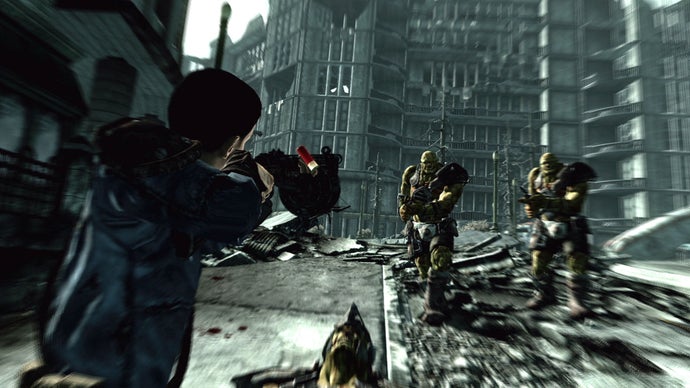
*Fallout 3* introduced nuanced stealth mechanics that allowed players to engage in a tense dance of detection—capturing the same spirit of unpredictability that characterized *Deus Ex*. Noises, movements, and even the simple act of lighting up a Pip-Boy could lead to unforeseen and chaotic results. The game made mistakes feel significant by ensuring that players faced the aftermath of their choices, echoing the design philosophy of *Deus Ex*.
#### A Legacy that Transcends
Many developers who worked at Looking Glass and Ion Storm have continued the legacy of immersive gameplay in their subsequent projects. Pagliarulo points out that the influence of *Deus Ex* has spread throughout studios like Arkane, whose work on titles like *Dishonored* reflects similar design philosophies. Despite this, it is curious that *Deus Ex*’s impact on *Fallout 3* often goes unrecognized. Pagliarulo himself remarked that players often overlook the deep-rooted connections between the immersive sim roots of early Bethesda games and the innovations introduced in *Fallout 3*.
Analyses often highlight the series’ inherent qualities without acknowledging that they were partly shaped by the tenets established by *Deus Ex*. This nuanced storytelling and emergent gameplay have become hallmarks of the franchise, creating a legacy that continues to influence developers and players alike.
#### Challenges of Integration
However, adapting the principles of *Deus Ex* to an expansive open-world RPG like *Fallout 3* presents unique challenges. The broader gameplay lens required players to navigate multiple systems and approaches, which demanded a balancing act between various playstyles. Pagliarulo recognizes this complexity, stating, “We let you play as any type of character you want, and there are all these systems. And so, if you want to shoot your way through or sneak your way through, we have to support all of it.”
While some may argue that subsequent titles, such as *Fallout: New Vegas*, deliver even greater freedom and choice, it is crucial to acknowledge the groundwork established by *Fallout 3*. It laid the foundation for more complex interactions and player decisions, largely due to Pagliarulo’s inspired approach drawn from *Deus Ex*.
#### Conclusion
As we reflect on the evolution of video gaming in the 21st century, it is clear that the ideas of *Deus Ex* have left an indelible mark on the industry. The principles of player choice, consequence, and emergent gameplay continue to resonate in contemporary titles, shaping the very fabric of immersive gaming experiences. Thanks to the pioneers like Emil Pagliarulo, the legacy of *Deus Ex* will undoubtedly endure, inspiring