
**Cultural Convergence of Combat and Gaming: Examination of the White House’s Polarizing Video**
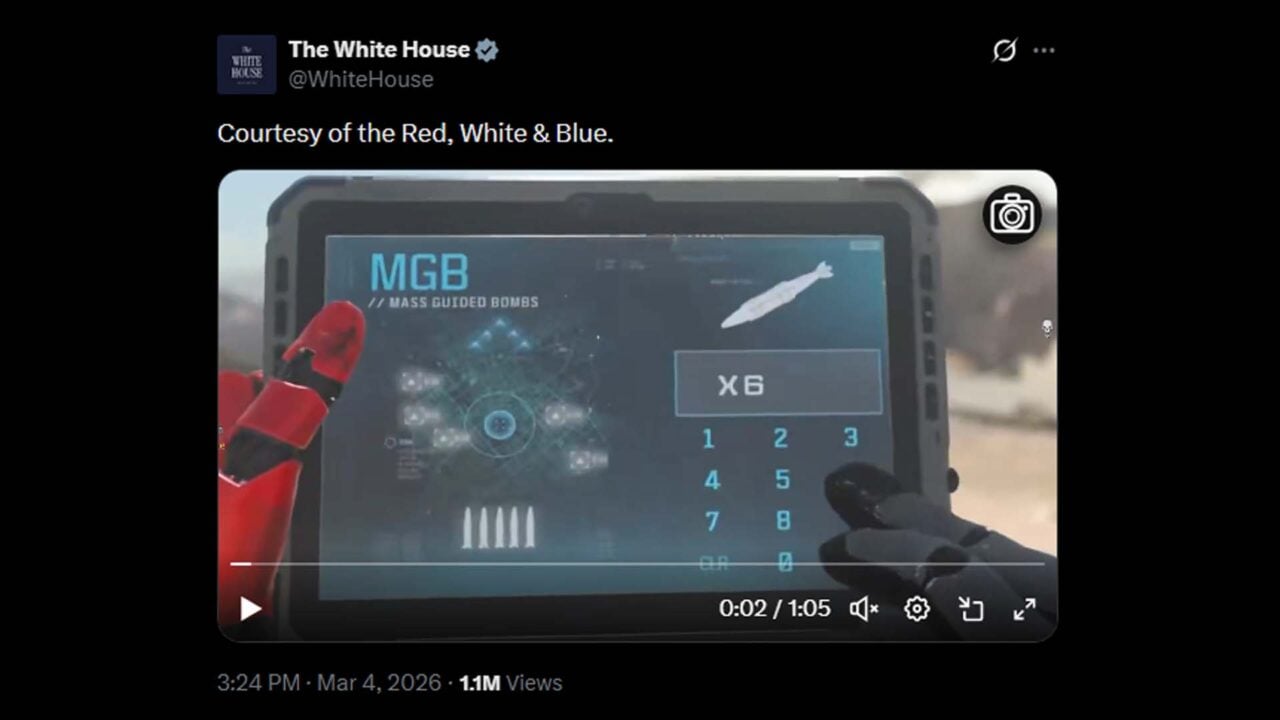
In the shifting arena of political dialogue, the merging of popular culture, especially video game elements, has begun to influence the narrative of official government communications. A recent event illustrating this trend occurred shortly after the United States, in alliance with Israel, carried out airstrikes on Iran, which reportedly resulted in numerous fatalities, including many innocent bystanders. In a daring and contentious action, the official White House Twitter account released a video on March 4 featuring a killstreak animation from the well-known game *Call of Duty: Modern Warfare 3* (MW3), inciting widespread backlash.
**Video Overview**
The one-minute clip shared by the White House opens with footage from *Modern Warfare III*, highlighting a player triggering an MGB killstreak—an ultimate gameplay feature that calls in a devastating strike capable of concluding the match. The official post included the phrase “Courtesy of the Red, White & Blue,” commonly used in various nationalistic situations. This combination of military imagery from actual strikes against Iranian targets alongside a gamified interpretation of warfare has faced criticism not only for its insensitivity but also for trivializing the humanitarian disaster stemming from the conflict.
The airstrikes have resulted in considerable civilian loss and have attracted intense international scrutiny. One of the most tragic incidents involved the missile attack on the Shajareh Tayyebeh girls’ elementary school on February 28, which led to numerous young civilian deaths. In the context of these events, employing a video game animation to depict military actions raises ethical concerns regarding the representation of warfare in government communications.
**Official Responses**
U.S. Secretary of State Marco Rubio addressed the issue, stating, “All that I know is that we’re investigating that. Of course, we never target civilians, but we’re taking a look at investigating that.” His comments emphasize the administration’s effort to navigate the complex moral and ethical challenges surrounding military actions while facing scrutiny regarding civilian deaths.
**Recurring Usage of Gamer Culture in Politics**
This video is part of a larger pattern; it mirrors a wider trend within the Trump administration’s interactions with gaming culture. In September 2025, the Department of Homeland Security (DHS) unveiled a video depicting armed personnel apprehending individuals, set to music from *Pokémon*. In addition, subsequent posts from DHS showcased imagery from the *Halo* series that compared immigrants to fictional foes, reinforcing a combative political narrative.
Critics, including prominent figures from the gaming industry, have voiced their apprehension regarding this trend. Marcus Lehto, co-creator of *Halo*, denounced the incorporation of gaming stories into political communication by asserting that it is “absolutely abhorrent.” Such responses reflect the unease stemming from linking entertainment platforms with serious and often tragic real-world scenarios.
**Final Thoughts**
The fusion of combat visuals with gaming culture not only raises red flags regarding the depiction of violence and its consequences but also points to a broader communication strategy that resonates with younger demographics. As the boundaries between entertainment and real-life implications blur, it is essential to reflect on the effects of illustrating sensitive topics within a gamified framework. The response to the White House’s recent video stands as a notable case study in the ongoing discourse regarding ethics, representation, and the influence of culture on public conversation.