**Emil Pagliarulo and the Paranoia of Fallout 4: A Reflection of South Boston’s Shadows**
Growing up in South Boston, Emil Pagliarulo lived in the shadow of the infamous crime boss Whitey Bulger, a figure that embodied fear and uncertainty for many. Known for his firm connections with local street gangs and notorious criminal enterprises, Bulger’s life was further complicated by his historical ties to Alcatraz and the CIA’s mind control program, MKUltra. For Pagliarulo, Bulger represented the ultimate boogeyman: an elusive presence that loomed large in the minds of those living in the area. “He was basically the boogeyman,” Pagliarulo recalls. “He was the evil bad guy. You didn’t know where he was or even what he looked like, but you knew he was out there. I’m 10 years old, and I know this name.”
Years later, as Pagliarulo and Bethesda Game Studios transitioned into the production phase of *Fallout 4*, these formative memories fueled the game’s narrative and atmosphere. The team recognized that the game was missing a vital theme: a pervasive sense of paranoia. Pagliarulo engaged in discussions with Todd Howard, leading to the decision to infuse this overarching sense of distrust throughout the gameplay and storyline.
This theme culminates in significant scenes within *Fallout 4*, particularly when players first arrive at Diamond City—an improvised settlement established on the grounds of Fenway Park. Here, players encounter a tense standoff: a man holding his brother at gunpoint, convinced that his sibling has been replaced by a synthetic doppelgänger. This scenario starkly illustrates the impact of the Institute, a shadowy organization that replaces residents with synths, thus perpetuating fear and chaos among the Commonwealth’s inhabitants.
Amid the backdrop of fear and uncertainty, *Fallout 4* also weaves in threads of hope. “Throughout all the bad stuff and paranoia, people are still trying to rebuild society,” Pagliarulo notes, highlighting a shift from mere survival, as seen in *Fallout 3*, to a desire for growth and community in the new game.
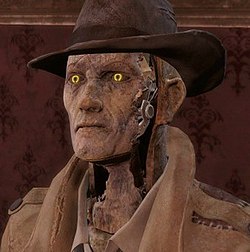
Central to this narrative is Nick Valentine, an early model synth who escaped from the Institute. His character serves as a beacon of humanity within the otherwise desolate world. Operating as a detective infused with the memories of a pre-war cop, Nick embodies optimism and kindness. His appearance—complete with synthetic features—reveals the blending of man and machine, prompting questions about identity and the essence of humanity.
Pagliarulo describes Nick’s role in Diamond City and the courage it takes for him to operate there. “It’s a really gutsy play for him to have an office in Diamond City,” he asserts, where the history of synth-related violence casts a long shadow. Nick not only seeks to prove his loyalty to the human residents through acts of service but also symbolizes the possibility of coexistence, urging others to find hope in despair.
Originally conceived with a noir detective aesthetic, Nick’s character evolved significantly throughout the game’s development. His creation was inspired by film noir classics, juxtaposed with a fresh perspective that avoids the typical cynical archetype frequently found in such narratives. Pagliarulo aimed to balance recognizable character traits against overused tropes, resulting in a character who is complex and relatable.
Nick Valentine also navigates philosophical quandaries about existence and consciousness, portraying a heightened level of self-awareness. “He’s probably the most self-aware character in the entire game,” Pagliarulo remarks, as Nick grapples with the legacy of the man he was designed to emulate while forging his own identity.
The questions surrounding Nick’s nature and the essence of humanity are further deepened in his narrative arc, particularly during his companion quest, where he seeks closure regarding his origin story. Confronting his past leads to moments of introspection, ultimately revealing his commitment to justice, self-definition, and personal meaning.
The character’s resonance with players has turned him into a fan favorite, reflected in the enthusiasm seen at cosplay events and the community’s appreciation for his rich backstory. His quest throughout the wasteland highlights not only the complexities of a pre-war detective’s life but also embodies the overarching themes of identity, memory, and the struggle to belong in a fractured world.
By integrating themes echoing Pagliarulo’s own experiences with fear and hope, *Fallout 4* serves not only as a backdrop for interactive storytelling but also as a platform for players—particularly those from Boston—to confront their historical anxieties, allowing them to explore narratives of survival, growth, and the intricate dance between humanity and artificial intelligence. Through the lens of Nick Valentine, the game enables a nuanced exploration of compassion, perseverance, and the complex nature of what it means to be alive—even in a world fallen to ruin.