# The Struggle Between Pleasure and Quality: An Exploration of *Timber Rush*
In the expansive realm of video games, it’s not unusual to discover titles that stir up mixed emotions. *Timber Rush* stands out as a game that has caught players’ attention, despite facing criticism for its straightforward design and gameplay mechanics. This article delves into the contradiction of relishing a game that one may perceive as fundamentally flawed.
## The Fundamentals of *Timber Rush*
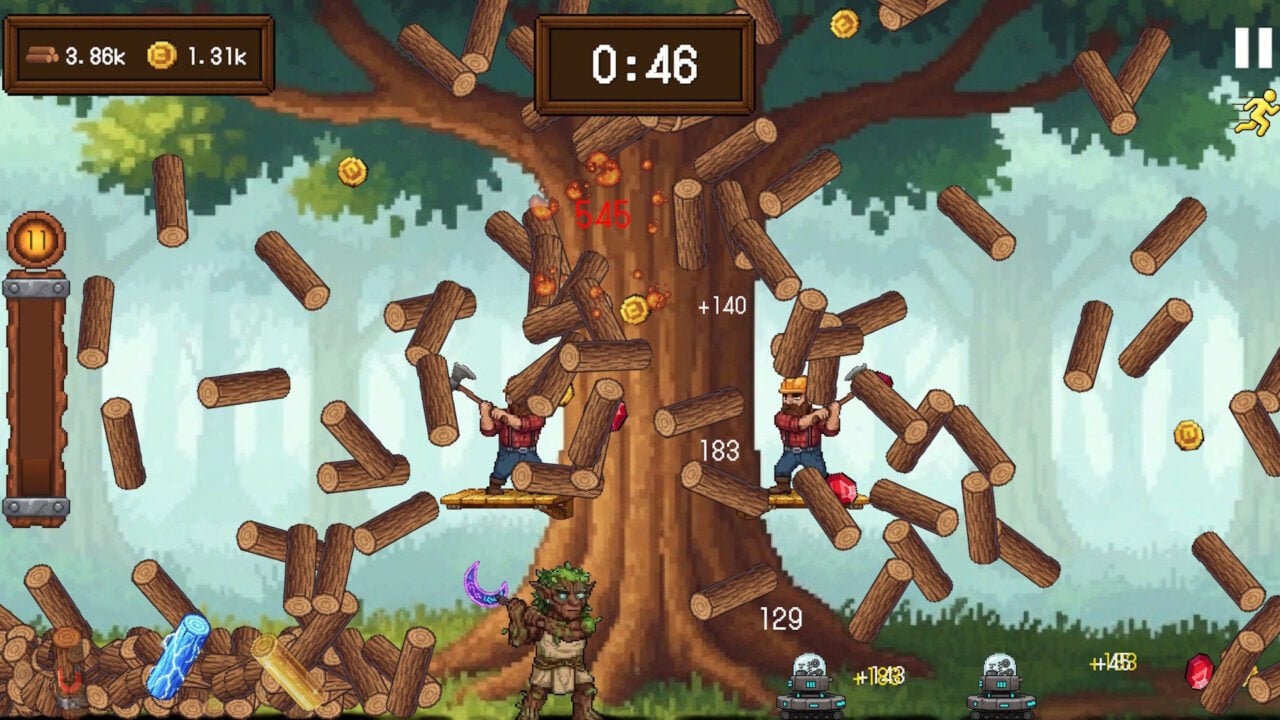
Fundamentally, *Timber Rush* is a clicker-style game centered on a lumberjack character dashing back and forth against a fixed background. Players are tasked with gathering logs, gold, and gems that mysteriously materialize from a tree trunk. The gameplay loop entails enhancing various abilities, acquiring new tools, and unlocking new crew members to assist in the never-ending endeavor of log collection.
Although the game appears to be mindless, it offers an extensive array of upgrade options that may bewilder players. With hundreds of branches available, each providing unique enhancements and capabilities, players often find themselves caught in a web of choices that propels their engagement.
## The Gameplay Cycle
The crux of *Timber Rush* is embedded in its gameplay cycle: running, gathering, upgrading, and repeating. Initial runs are short, around 30 seconds, but players can prolong their time as they collect resources and enhance their character’s abilities. As players navigate the upgrade tree, the game shifts towards automation, lessening the requirement for direct player involvement. This automation fosters a sense of ease, as the game mechanics drift into the background while the numbers continue to ascend.
This design raises questions regarding player agency and involvement. Are players genuinely engaged with the game, or are they trapped in a loop of repetition disguised as entertainment?
## The Pleasures and Irritations of *Timber Rush*
The allure of *Timber Rush* arises from its capacity to inspire a “just one more round” mindset, akin to classic games like *Snake*. Players find themselves pulled towards the simplicity and repetitive qualities of the gameplay, even as they acknowledge its flaws. This dissonance between identifying a game as “objectively dreadful” while still deriving enjoyment presents an existential conundrum for players.
Players frequently scrutinize their tastes: Is it reasonable to take pleasure in a poorly designed game solely for its addictive mechanics? Or does that enjoyment undermine the worth of more refined and carefully crafted titles?
## The Role of the Developer
Another aspect to consider is the role of the developer, Allerton Apps. Engaged in player conversations, the developers show appreciation towards users providing feedback—revealing their commitment to refining the game. This attentiveness adds complexity to the relationship players share with *Timber Rush*. It encourages contemplation on how players view a game’s value not only through its mechanics but also in its development journey and community involvement.
## Conclusion
In the end, *Timber Rush* epitomizes broader themes in gaming culture, notably the tension between quality and enjoyment. Players must wrestle with their experiences and preferences, questioning the idea that fun should coincide with excellence. This ambivalence sparks deeper discussions about the nature of games, their design, and their influence on players.
Whether one departs from *Timber Rush* feeling foolish or enlightened, the game undeniably reflects the intricacies of modern gaming and individual tastes. Ultimately, the enjoyment derived from such a game may not warrant justification; it simply exists as part of the countless ways individuals discover joy in digital experiences.