
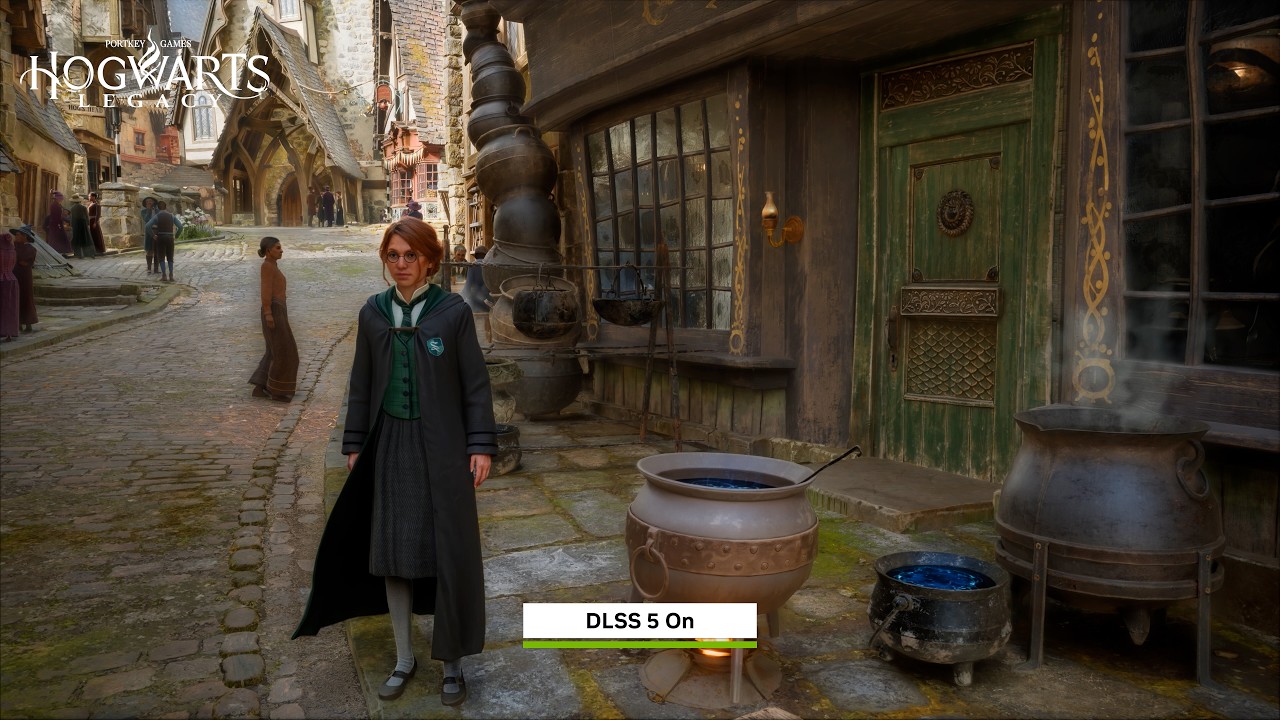
**DLSS 5: The Next Step in Nvidia’s AI-Driven Graphics Revolution**
Earlier this year, Nvidia introduced DLSS 5, an enhanced version of its Deep Learning Super Sampling (DLSS) technology, which leverages the power of its GPUs to dramatically improve the resolution and framerate of PC games. This advancement comes at a time when Nvidia finds itself in a complex position, having achieved unprecedented market value while simultaneously becoming a prominent player in the ongoing AI revolution. However, this has also created challenges for their core audience—PC gamers—who are grappling with soaring graphics card prices due to Nvidia’s focus on crypto mining and AI startup demands.
**Understanding DLSS Evolution**
To comprehend the significance of DLSS 5, it’s essential to recap the technology’s progression through its earlier iterations. Launched with the aim of enhancing game performance, DLSS initially functioned by rendering frames at a lower resolution and using AI to upscale them, generating a larger image without the computational cost of full resolution rendering. The first version required game-specific training, but DLSS 2 expanded capabilities to adapt to games it hadn’t been specifically trained on, leading to remarkable framerate boosts.
In subsequent updates, such as DLSS 3 and 4, Nvidia introduced frame generation techniques, enabling AI to create synthetic frames to further increase framerate. DLSS 4.5 even elevated this by generating multiple synthetic frames per rendered one.
**The Groundbreaking Approach of DLSS 5**
DLSS 5 marks a departure from previous versions by generating 100% of the content displayed on screen. It does not merely upscale rendered frames; instead, it completely regenerates them, allowing for alterations in textures, lighting, and overall image quality. This bold shift aims to make the technology noticeable, with Nvidia promoting features such as “infused” pixels and “photoreal” lighting effects.
Despite the innovative approach, DLSS 5 faced criticism regarding potential overreach into developers’ artistic control. Nvidia assures that developers will still have customization capabilities, with notable industry players like Bethesda and Capcom expressing enthusiasm for integrating this new technology into their games.
**Concerns and Future Implications**
Critical discussions have emerged about the consistency of output when using a neural model, questioning how Nvidia will manage variable results across different game engines and the implications that extensive reliance on such technology may have on game design and quality. Moreover, the current requirement for advanced and costly hardware to utilize DLSS 5 poses challenges for accessibility in the gaming community.
CEO Jensen Huang hinted at ambitious future applications for DLSS 5, including its potential to facilitate radically different visual styles—a notion that could redefine game aesthetics and artistic expression. This raises concerns that DLSS 5 may evolve into the default rendering method for games, granting Nvidia substantial control over the gaming landscape, potentially hindering independent developers and smaller hardware manufacturers.
**Artistry in the Age of AI**
DLSS 5 serves as a microcosm of today’s AI industry, illustrating how large tech entities can shape creative domains. While the push for greater graphics quality and higher framerates is driven by consumer desire, the implementation of technologies like DLSS 5 should prompt developers and gamers alike to reflect on the broader definitions of good art and the compromises made in pursuit of visual fidelity.
As the gaming industry continues to navigate technological innovations, DLSS 5’s introduction signifies both the exciting possibilities of AI-rendered graphics and the challenges of maintaining artistic integrity amidst rapid advances. The fate of this technology and its impact on the gaming experience call for thoughtful consideration of what animation and graphics mean in an increasingly AI-driven world.