### Pragmata: A Deep Dive into Capcom’s New Third-Person Shooter
**Introduction**
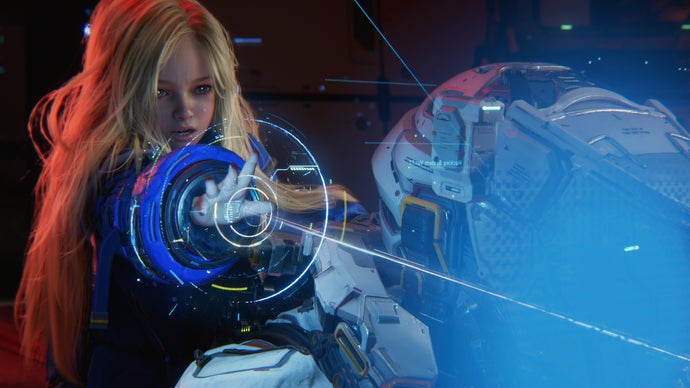
Pragmata, developed by Capcom, introduces players to a unique blend of third-person shooting mechanics and puzzle-solving through hacking. Set on a moonbase, players take on the role of Hugh, a rugged space father figure, and his companion, Diana, a small girl android who aids in battle through her hacking abilities. This article explores the gameplay mechanics, thematic elements, and the perspectives of players regarding the game’s innovative yet contentious features.
**Gameplay Mechanics**
At the heart of Pragmata is the hacking mechanic, which involves players completing a real-time minigame. The minigame requires moving through a grid to reach designated squares to disable enemy robots’ defenses. This feature is crucial as it adds a layer of strategy to the encounters, allowing players to disrupt foes before attacking. Additionally, simpler hacking tasks serve to unlock doors and set traps, promoting an engaging interaction with the environment.
However, opinions on this hacking mechanic are mixed among players. One recurring theme in discussions is the feeling of tedium as the hacking system seems to plateau after a certain point. Though players gain new modifications to diversify their approach, some feel that the core mechanic lacks sufficient evolution to maintain engagement throughout lengthy gameplay sessions.
**Level Design and Exploration**
Pragmata’s levels are described as dense and sprawling, reminiscent of classic games that emphasize exploration and collection of items. Players often find themselves navigating through intricate areas where in-game maps may not provide clear guidance, as they only indicate the sector rather than precise locations. This design choice aims to encourage exploration, but it can also become exhausting for players who prefer clearer navigation.
The game’s environments offer opportunities for players to hack various in-game elements, but feedback suggests a desire for more creativity in these interactions. Suggestions include enabling hacks on mechs or further developing environmental puzzles that go beyond basic functions.
**Character Dynamics and Gameplay Experience**
The dynamic between Hugh and Diana plays a significant role in the gameplay experience. While players alternate between shooting as Hugh and hacking as Diana, there is a sense of merging their roles into a cohesive gameplay style. Critics argue that both characters could have distinct moments of gameplay where their unique abilities shine more brightly. The occasional moments where players switch solely to Diana’s perspective offer a refreshing gameplay change but may not be enough to significantly impact overall gameplay satisfaction.
**Comparative Analysis with Other Games**
Pragmata’s hybrid mechanics draw comparisons to other games with similar dual-action systems, such as the active reload feature in Gears of War and the multi-character control in The World Ends With You. Players have reflected on the challenge of balancing attention between multiple gameplay elements and how such mechanics can either enhance or detract from the player experience.
While some players thrive on managing complicated systems, others may find it exhausting. This highlights the diversity in player experiences and offers insight into how different gameplay elements resonate uniquely with individuals.
**Conclusion**
In conclusion, Pragmata presents an intriguing fusion of third-person shooting and puzzle-solving through hacking, enriched by a distinctive narrative set in a sci-fi universe. While the game shows promise with its engaging mechanics, the mixed opinions about the hacking system and exploration reveal areas for potential improvement. As Capcom moves forward with Pragmata, feedback from players can serve as a catalyst for evolution in future sequels, allowing for a deeper, more varied experience that combines creativity, strategy, and exploration.