### Amberspire Review: A Dance with an Alien Moon
**Developer:** Lunar Division
**Publisher:** Bithell Games
**Release:** May 6th, 2026
**Platform:** Windows
**Price:** $22.50/£18/€22.50
**Reviewed on:** Intel Core-i7 12700F, 16GB RAM, Nvidia RTX 3060, Windows 11
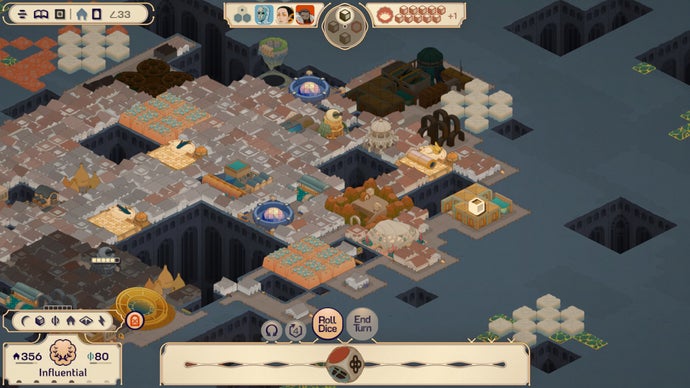
Amberspire is not your typical city-builder. Developed by Lunar Division, known previously for The Banished Vault, this turn-based boardgame puzzler places you in a peculiar setting—an alien moon that serves as a mausoleum over a sprawling necropolis. Rather than constructing a city in the classic sense, players must navigate the chaos of unpredictable, city-oriented agencies across a moon-sized graveworld marked with archways and catacombs.
The game immediately defies the conventional goals of city-building. You are not simply aiming to create a thriving metropolis; instead, you’re grappling with the haunting beauty of a dead world, finding joy in “dancing” with its unique ecology. Your burgeoning city, no matter how technologically advanced, remains just another layer of disruption on this fragile world. This juxtaposition frames the gameplay, where the focus shifts to managing resources amid a landscape that is as treacherous as it is enchanting.
#### Gameplay Mechanics
The core mechanics of Amberspire revolve around adjacency and resource management rather than direct construction techniques typically seen in city simulators. Players begin with basic facilities like kilns and crystalisers that produce essential materials. As you expand, new buildings like observatories and teahouses come into play, broadening your city’s potential and unlocking valuable Influence points through trade.
However, resource gathering is nuanced; your buildings produce dice with various outcomes instead of direct materials. Each turn, you can select and roll up to six of these dice, creating uncertainties and potential setbacks in your plans. This unpredictability injects a vital layer of strategy into the game, as the results of your rolls may require you to pivot and adapt your strategies frequently.
Expansion is further complicated by the unpredictable nature of your citizens. Unlike traditional builders where you control placement, here, citizens construct their homes based on designated zones, leading to unexpected city layouts and challenges in planning your infrastructure.
#### The Climate of Amberspire
Every fourth turn introduces Amberspire’s own dice, representing chaotic weather patterns that affect procedural terrain types. The challenges of this ominous climate require players to actively manage buildings meant to mitigate weather hazards or else risk losing valuable structures. The instability inherent in the terrain, complemented by these weather effects, adds a continuous layer of challenge to city management.
Instability dice that represent the structural decay of the moon’s surface arise from gameplay actions, such as demolishing structures. This unique twist on failure means that the consequences of your decisions can ripple outwards, causing significant city upheaval unless you tread carefully. Even in the face of chaos, players are encouraged to embrace the notion that collapse and failure are part of the intricate tapestry of Amberspire’s existence.
#### Cultural Evolution
As your city evolves, so too does the nature of what you produce. Traditional resources give way to more abstract outputs—concepts like “void,” “tides,” and “ritual” emerge. This shift reflects an intriguing evolution of value within the game and challenges players to rethink their objectives, as your actions lead you to cultivate an emergent culture amid a persistent existential threat.
Amberspire nudges players to rethink what constitutes success in a city simulation. Losing a structure due to a cataclysm or a failed weather turn isn’t the end; rather, it becomes an opportunity to reimagine and rebuild. The whimsy of connecting the dots of a fragmented city, filled with unpredictable outcomes, fosters a richer experience than merely achieving perfection.
#### Conclusion
Amberspire is a mesmerizing blend of challenging gameplay and captivating aesthetics that invites players to engage with its chaotic design. While it may initially frustrate with its complexities, the playful nature of its systems encourages repeated playthroughs and a deeper understanding of its rhythms.
Your city may end up looking like a haphazard collection of structures, yet there is beauty in the imperfection. Ultimately, Amberspire isn’t about crafting a polished gem; it’s about experiencing the flawed intricacies of a vibrant, living world, reminding players that growth often comes amidst the chaos. The journey within this alien moon challenges preconceptions of city-building, delivering a truly unique and entrancing experience.