**Moderate Spoilers for Subnautica 2’s Incomplete Early Access Storyline**
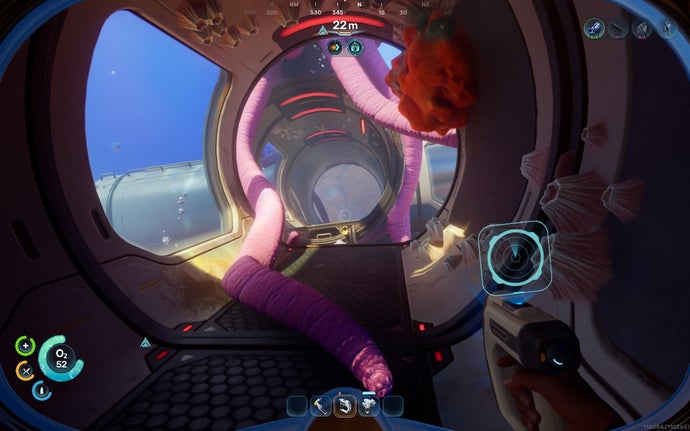
When playing *Subnautica 2*, a distinct contrast between two realms becomes apparent. One realm consists of creatures and environments functioning independently of the player, showcasing the vibrant ecosystems of the game. Shoals of creatures dart about, laboratories reveal remnants of past life, and territorial sharks circulate their domains. The other realm caters to the player’s actions, offering a structured experience where crafting and progression dictate the landscape, creating an environment that feels at times predictable and contrived.
This dichotomy is reminiscent of discussions surrounding the open world genre, particularly the critique of player-centric narratives that overshadow the existence of non-player entities. Nikhil Murthy, a developer and writer, elaborates on the dangers of such a framework that positions the player as the center of the universe, noting that it dilutes the significance of other characters and stories that exist in the game world. This idea resonates within *Subnautica 2*, where, despite the engaging open world, there’s an underlying current that seeks to challenge the complacency often inherent in these designs.
*Subnautica 2* leans into what can be described as a “postcolonial” approach. While it retains elements of the familiar “amusement park” structure typical in open worlds, it diverges significantly from players’ expectations, especially in terms of its narrative and gameplay. Here, players are less conquerors and more indentured laborers, represented through the protagonist — a clone created by an AI named Noa. Instead of embodying a hero, the player navigates a chilling landscape of control and manipulation.
The story evolves around two contending forces: Noa, an insidious AI, and a mysterious organic entity embodying the ocean itself. Noa seeks control over its clones, providing crafting recipes while imposing a medical regimen that echoes the darker side of its automated authority. The game confronts traditional hero narratives by centering on survival rather than domination. Instead of hunting the grand beasts of the ocean, players are nudged to explore and interact without resorting to violence, inviting a deeper reflection on their role within this fractured world.
Within the current early access version, players find themselves caught in a web of conflicting motivations: uncovering the fate of previous explorers while balancing between the whims of an AI overlord and the mysterious organism that alters life around it. Tales of fellow settlers intertwined through audiologs reveal differing philosophies on confronting Noa and embracing or resisting the oceanic force.
Moreover, the non-violent gameplay serves as a critique of the typical open-world designs that mandate player conquest. Unlike the traditional systems that reward killing or domination, *Subnautica 2* promotes exploration and engagement with the world on its terms. This non-violence creates a tension, as many players accustomed to traditional gaming paradigms may feel frustrated by the absence of combat-based resolution.
The ecosystem of *Subnautica 2* is notably dynamic, with creatures interacting with one another beyond player influence, creating a sense of a living world. However, it is also carefully constructed to prevent radical changes that would disrupt the player’s journey, maintaining a delicate balance between realism and gameplay expectations.
Despite these intricate details, exploring *Subnautica 2* prompts reflection on agency within gaming. A truly postcolonial design could allow players to emerge not as the harbingers of change, but as witnesses to unfolding events in a world rich with history and depth. Conversations around the absence of weapons and the implications of non-violent interaction showcase this exploration of agency and consequences.
In conclusion, *Subnautica 2* offers a fresh take on open world design, subverting traditional expectations through its intricate narrative, unique characters, and environmental interactions. By challenging the player’s role from aggressor to observer, it raises significant questions about our portrayal of worlds and narratives in gaming, paving the way for future explorations of identity, power, and involvement in digital landscapes.