## Intel’s Panther Lake Laptops: A Bright Spot Amidst Challenges
Intel has experienced turbulent times recently, particularly with significant setbacks over the past couple of years. A notable multi-billion dollar loss in 2024 led to the departure of then-CEO Pat Gelsinger, and their flagship Core Ultra 200S desktop chips struggled in gaming benchmarks, causing a further loss of market share to competitor AMD. However, the introduction of Intel’s Panther Lake CPUs marks a potential turnaround, receiving positive acknowledgment for their performance—especially in the realm of portable gaming.
### Overview of Panther Lake CPUs
Following the relatively successful Lunar Lake laptop processors released in 2024, the next-generation Panther Lake—officially known as the Core Ultra Series 3—has garnered attention for its potential capabilities. Featuring the integrated Arc B390 GPU, these chips promise gaming performance comparable to a discrete Nvidia RTX 4050 on paper.
### Testing the Panther Lake Performance
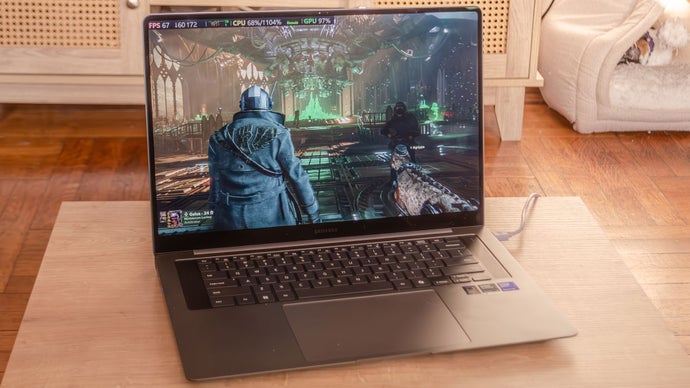
In a hands-on trial, various laptops powered by the Panther Lake processors were put through their paces. One standout system used for this evaluation was the Asus ZenBook Duo 2026, equipped with an Intel Core Ultra X9 388, a 12 Xe3-core Arc B390 iGPU, a robust 32GB LPDDR5 RAM, and a 1TB PCIe SSD. Additionally, systems such as the MSI Prestige Flip 14 AI+, Samsung Galaxy Book 6 Pro, and Asus ExpertBook were also tested, demonstrating mid-range capabilities with Core Ultra X7 358H chips and similar specs.
### Gaming Capabilities
Historically, thin and light laptops have been limited in terms of gaming performance, particularly with demanding titles. The test period focused on notable titles such as **Cyberpunk 2077**, **Warhammer 40,000: Darktide**, and **Path of Exile 2**. Overall, Panther Lake processors showcase remarkable capabilities; maintaining frame rates between 45 to 60 fps on moderate settings while playing at 1080p is impressive for laptops in this category.
Despite encountering minor stuttering during intense gameplay scenarios, the overall experience remained solid. This was especially noticeable in **Doom: The Dark Ages**, where achieving stable frame rates necessitated reduced graphical settings, illustrating that while the iGPU is powerful, it still struggles with the most demanding scenarios.
In contrast, **Cyberpunk 2077** sustained a playable 50-60 fps. Even during the most taxing moments, frame rate drops into the mid-40s did not significantly hamper enjoyment. **Path of Exile 2** performed exceptionally well, enjoying average frame rates of around 70 fps, indicating that the Panther Lake chips are highly versatile.
### Power Performance
Notably, gaming performance remained consistent regardless of whether the laptops were plugged in or running on battery power, a common limitation for many gaming laptops. Provided the power profile settings remained the same, users could expect similar performances in both scenarios.
### Side-by-Side Comparisons
Performance observations revealed that there was no significant distinction between the Core Ultra X7 and X9 in gaming applications, with significant advantages appearing, instead, in synthetic benchmark results, such as Cinebench or 3DMark.
### Looking Ahead: Competitive Landscape
While the integrated Arc B390 may not be revolutionary in ray tracing capabilities, it stands out for delivering commendable frame rates in a competitive price range against similar products. Nvidia’s upcoming RTX Spark SoC may present new challenges, but current offerings suggest a competitive advantage for Intel in the portable gaming sector.
### Conclusion
Despite challenges in the desktop CPU market and the disappointments accompanying the Core Ultra 200S series, the Panther Lake processors signify a new focus for Intel within the gaming laptop market. Their enhanced performance capabilities, especially when paired with integrated graphics, offer a glimmer of hope for Intel’s prospects in gaming technology. As attention turns toward the upcoming Nova Lake series, Panther Lake serves as a promising bridge toward a brighter gaming future for Intel.