**The Evolution of Weirdness in Assassin’s Creed and Its Offshoots**
The Assassin’s Creed franchise has grown to encompass numerous titles, many of which have drawn inspiration from the original series. However, it is easy to lose sight of how the first installment was quite unconventional, particularly for a game of its magnitude. When Ubisoft unveiled the title with a captivating trailer featuring Altaïr confronting Templars, the subtle flicker of code hinted at a deeper narrative—a digital facade set against the backdrop of the medieval Crusades.
One of the most distinctive aspects of the original Assassin’s Creed was its control scheme. Players took on the role of an Animus user, controlling a simulation of their ancestor through limb-corresponding buttons, which felt both novel and disorienting at a time when third-person game controls were still evolving. This unique mechanic provided a sense of estrangement that has become less pronounced in the later iterations of the franchise.
In a parallel vein, the recently revived game **1666: Amsterdam**, helmed by original Assassin’s Creed director Patrice Désilets, promises a similarly bizarre experience. This supernatural narrative reflects a retelling of conspiracies across centuries, substituting the Animus technology for a mix of compelling witchcraft and mystery.
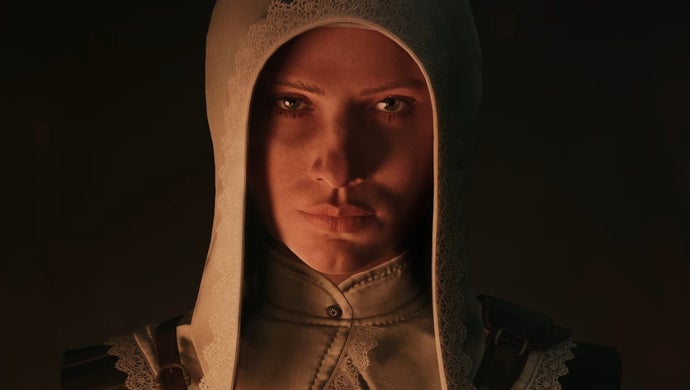
The **1666: Amsterdam** prologue immerses players in a narrative that spans multiple eras and characters, each linked by a thread of bodily fluid exchanges. Initially, players embody a crimson sorceress in the 17th century, whose powers allow her to channel energy to navigate a surreal landscape filled with gnarled trees and peculiar felines. This segment hints at a larger role for the sorceress throughout the full game.
Transitioning to the modern era, players take on the role of Clio, who explores an occult library seeking answers from a quirky professor regarding a mysterious tome left by her father. This interaction evokes stylistic parallels with **Dan Brown’s The Da Vinci Code**, weaving convoluted riddles into the narrative. Clio’s journey leads her to bleed on the tome, triggering a flashback to New Year’s Eve 1999—the night of her own conception, adding a layer of intrigue and discomfort to her exploration.
The final character players control is Aaron, Clio’s father, whose narrative becomes entangled with Clio and the sorceress through a series of bizarre events, including a transformation that leads him from a human form to that of a cat. This transition allows for unique gameplay mechanics as players navigate a twisted version of the hotel, ultimately linking back to the sorceress.
The game relies heavily on HUD prompts to guide players through its complex narrative, which features multiple characters and shifting control schemes. The intricate instructions and mystical runes enhance the sense of disorientation, mirroring the original Assassin’s Creed’s unconventional mechanics.
Interestingly, the landscape of Assassin’s Creed continues to evolve, with Ubisoft currently developing a new title exploring witchcraft in the Holy Roman Empire. This project potentially mirrors ideas originally conceived for **1666: Amsterdam**. Désilets began working on this project over a decade ago, facing significant challenges when Ubisoft took control of the studio, leading to his ousting.
The potential competition between Ubisoft’s upcoming game and Désilets’ vision sets the stage for a unique clash within the gaming world. While Ubisoft’s title will benefit from a larger development team, it will be intriguing to see how it compares to a game that explores such audacious themes as family bonds and reincarnation through the lens of fantasy and folklore.
For those interested in experiencing the peculiarities of **1666: Amsterdam**, the prologue is available on platforms like Steam. It’s a chance to engage with a project that embodies the weirdness reminiscent of the original Assassin’s Creed while showcasing the ambitions of its creator in a narrative intertwined with history and the supernatural.