Easily missed among last week’s [Summer Game Fest](https://www.rockpapershotgun.com/events/summer-game-fest-2026) advert marathon was the [Latin American Games Showcase](https://www.youtube.com/watch?v=dKmI5Yku9Bw): an exhibition that, at over eighty games strong, dwarfed the Keighley-fronted main event, yet has received only a small fraction of the eyeballs. Less than two months earlier, 154,000 visitors poured into Gamescom Latam to see games made across Brazil, Colombia, Argentina, Costa Rica, Mexico, Uruguay and more – but while that attendance was [up 17.5%](https://www.gamesindustry.biz/gamescom-latam-attendance-up-by-175-in-2026) on the previous year, it totalled less than half the footfall of 2025’s Gamescom Cologne.
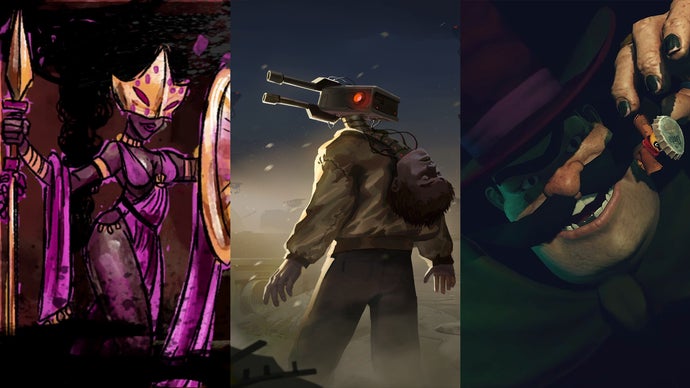
All the same, the audience gap faced by Latin America – to use the umbrella term for this vast and varied collection of nations – does not reflect a scarcity of clever or imaginative games. The diverse works being produced in these countries are as original as dinnertime RPG [Family Reunion](https://www.rockpapershotgun.com/family-reunion-is-a-dinnertime-simulation-game-that-captures-the-wonder-and-boredom-of-being-a-loosely-disciplined-7-year-old), as challenging as slavery-era naval battler [Black Sailors](https://store.steampowered.com/app/4230650/Black_Sailors_Bay_Of_All_Saints/), and as eye-catching as handpainted action-roguelike [Talaka](https://store.steampowered.com/app/3815370/Talaka/). The wider industry is taking note, too, with huge stacks of dollars pouring into Mexican, Brazilian, Argentinian, and Chilean organisations from the traditional powerhouses of North America and Europe.
However, this investment usually isn’t for the benefit of original games. At least, not directly. As it’s told by the creators themselves, the story of game development in these countries is one of a region that’s being mined for cheap, outsourced talent – yet has also formed a continent-spanning creative force, often by drawing directly from its own extensive range of cultures and histories.
Even as a visiting hack, it was abundantly, face-punchingly obvious from my time at Gamescom Latam 2026 that outsourcing (or as it’s more professionally called, ‘external development’ and/or ‘work-for-hire’) is big business. Panel discussions encouraging the practice share a stage with awards ceremonies, while major industry players like Microsoft, Nintendo, and Obsidian are represented by outsourcing and dev relations managers rather than the usual, more public-facing PR and marketing staff. The private business-to-business area is dominated by dozens of tiny tables in a speed dating arrangement, where developers are given 20 minutes – timed by giant digital clocks on either side of the pen – to pitch themselves to publishers. Few bring laptops with playable builds of their own games; many, many of these meets are for talking services.
It would be unfair to frame external development – great, now *I’m* saying it – as something more sinister than the result of classic, capitalistic economic algebra. Big companies elsewhere want some extra QA or concept art or engine work done, certain developers are willing to do it at a lower price, and – I’m told – are often paid in US dollars, a stronger currency than the Mexican peso or Brazilian real. In theory, everyone wins. But, like any form of freelancing, it’s unstable work. A [2024 survey](https://drive.google.com/file/d/1zXJTX0G5oZb9KDIR28Uef6fvuLBviuih/view) of Argentinian game developers, by Women in Games Argentina, found that only 48% of respondents were in permanent staff roles.
As far as many developers are concerned, though, any work is good work. For Fábio Rosa, co-founder of indie studio Coffeenauts – who just presented their Terminator-inspired, side-scrolling survival adventure [Ghostless](https://store.steampowered.com/app/2506520/GHOSTLESS/) in the Latin American Games Showcase – the reasoning for accepting work-for-hire gigs is simple.
“Because of money!,” he exclaims. “Because we need to get the cash flow going.” The shorter, safer development cycles of external development jobs may also appeal – it’s quicker and thus an easier commitment to put together a 3D model, or port a game instead of building one from scratch – but funding, of any sort, remains the biggest draw.
“In Brazil,” Rosa explains, “you have a lot of studios that do external development, and then you do