### The Trials of Jedi Integration in Star Wars Galaxies
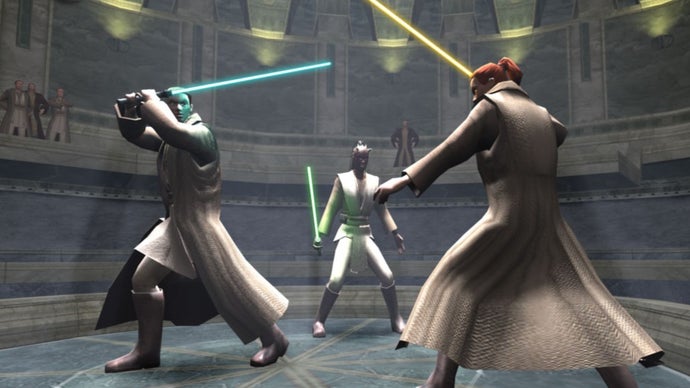
In the early 2000s, the video game industry was buzzing with excitement as developers pursued the challenge of integrating beloved characters and concepts from popular franchises into massively multiplayer online games (MMOs). One of the most ambitious projects during this time was Sony Online Entertainment’s *Star Wars Galaxies*, a game that launched in 2003 and ran until 2011. A monumental aspect of its design was the inclusion of Jedi characters, an undertaking fraught with complexities as developers sought to maintain class balance while also fulfilling the iconic fantasy of wielding the Force.
#### The Necessity of Jedi
Raph Koster, director of *Star Wars Galaxies*, reflected on the inherent need to include Jedi in the game, acknowledging that the allure of Jedi—their powers, their iconic status—was too strong to ignore. Set between the events of *A New Hope* and *The Empire Strikes Back*, the game was developed during a tumultuous time in the Star Wars universe, when Jedi were rare and hunted by the Empire. This backdrop posed unique challenges; how could developers create a compelling Jedi experience that did not undermine the game’s balance?
#### The Hidden Path Concept
Initially, the development team considered implementing a “hidden path” to becoming a Jedi. Koster explained that the idea was to make unlocking this powerful class an arduous and secretive process, inaccessible through typical character creation. The intention was to deter players from easily accessing Jedi powers, thereby retaining the excitement and mystery surrounding these characters.
However, the original design concepts proved impractical. Tracking numerous specific activities was cumbersome, leading the team to pivot towards a system based on unlockable skills. While this was more manageable, it also simplified the requirements far too much, allowing players to reverse-engineer the criteria necessary to become a Jedi.
#### Balancing Power and Appeal
To maintain balance within the game, the developers expored various options to temper the power of Jedi without rendering them ineffectual, ultimately weighing two primary approaches: either reducing their power to be comparable to other characters, like Han Solo, or creating formidable Jedi with trade-offs. Koster suggested player mechanics inspired by games like *Diablo*, where Jedi characters would face the constant threat of being hunted by the Empire. This concept encouraged players to avoid using their powers excessively and maintain a low profile, similar to a stealth game, but it ultimately met resistance due to the imposing nature of permadeath mechanics.
Players expressed concern over losing their characters due to issues like internet lag, which was especially prevalent during the mid-2000s. Consequently, the team discarded the permadeath feature in favor of designing a more conventional, albeit flawed, skill-tree approach to unlocking Jedi powers.
#### The Fallout of Simplified Systems
The shift from a complex to a simpler system allowed players to unlock Jedi through a series of skill advancements, fostering expectation and urgency from the marketing team eager to capitalize on Jedi appeal. Unfortunately, this accessibility undermined the core fantasy that Jedi were rare and exceptional, leading many players to abandon their specializations in pursuit of Jedi mastery, ultimately diluting their experiences.
Koster shared that catering to the desire for Jedi led to widespread dissatisfaction among players, who found themselves forced into gameplay styles they did not enjoy, negatively impacting player retention and overall game engagement.
#### Legacy and Reflections
Ultimately, the ambitious integration of Jedi into *Star Wars Galaxies* reveals the intricate balance between creativity and practicality in game design. Koster acknowledged that despite the potential struggles and failures, the contributors to *Star Wars Galaxies* had forged a unique MMORPG experience that continues to resonate within the gaming community.
Despite its closure, *Star Wars Galaxies* remains alive on private servers, sparking renewed interest and aspiration within its dedicated fanbase. Raph Koster’s reflections on the game’s design and its challenges serve as a significant analysis of how ambition can encounter real-world constraints in the ever-evolving landscape of video games.