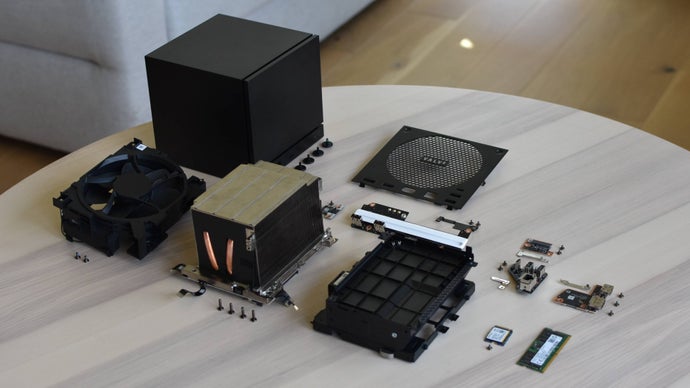
# Taking Apart the Steam Machine: An Accidental Teardown Experience
What began as a simple curiosity about the RAM setup of Valve’s Steam Machine quickly transformed into a full teardown of the device. The layered and compact design of this small PC necessitated the removal of several components to access others, leading to a desktop cluttered with parts. While it was not a complete catastrophe, it certainly provided a comprehensive look into the Steam Machine’s upgrade potential, repairability, and internal structure that many users may find insightful.
## The Teardown Process
Opening the Steam Machine proved to be much simpler than anticipated, particularly when compared to the challenge of opening a Steam Deck. With just a few turns of a Torx screwdriver—specifically removing two screws at the back and four hidden in the feet—the entire internal assembly could slide out. This simplicity is quite refreshing and a notable departure from the more complicated assembly of handheld devices like the Steam Deck.
Inside, the Steam Machine reveals a tightly packed arrangement of components. The design highlights an industrial beauty that efficiently utilizes space, with every square centimeter filled with essential parts. Accessing internal components can be daunting due to their interdependence; for instance, certain pieces must be removed before others can be accessed, a stark difference from the straightforward accessibility of traditional desktop PCs.
## Upgrade Potential and Challenges
Upgrading or replacing components of the Steam Machine is not without its challenges. A significant observation during the teardown is the extensive number of steps involved in tasks like replacing the SSD or upgrading RAM—reportedly about thirty-nine steps for a simple SSD replacement and RAM upgrade. This complexity can deter novice tinkerers, especially those accustomed to traditional tower desktops where components are often more readily accessible.
Fortunately, for those contemplating upgrades, the Steam Machine does offer some relatively easy modifications. The SSD slot, accessible immediately upon removing the assembly, allows for either a Steam Deck-sized 2230 drive or a standard 2280 SSD after repositioning a screw stud. While it uses a PCIe 4.0 interface—meaning newer PCIe 5.0 drives won’t achieve their maximum speed—it is still a practical upgrade path with reasonably priced options available in that format.
Conversely, changes to the CPU or GPU are not feasible, as they are integrated components within a proprietary motherboard design. The RAM does present an upgrading opportunity, as it features two DDR5 SO-DIMM slots, but with only one occupied by a 16GB stick. Adding a second stick is possible, but the effort required to access those slots beneath layers of components may not justify the minor performance gains that could be achieved.
## Repairability Insights
One of the surprising benefits of the Steam Machine’s teardown experience is its potential for repairability. Although you can’t separate the CPU from the motherboard like in a traditional desktop, many non-core components can be individually replaced. This design approach makes it significantly easier to swap out defective parts without needing to replace the entire unit.
Each section, from I/O ports to the microSD card reader and even the GPU output ports, can be detached separately, which is often not possible with similar devices. While the current availability of replacement parts is still underdeveloped, with Valve planning to collaborate with iFixit for future support, the groundwork for a repair-friendly system is already in place.
## Conclusion
Overall, the accidental teardown of the Steam Machine sheds light on its design philosophy, marked by compactness, upgrade limitations, and an intention towards repairability. Although the process of accessing and modifying components can be labor-intensive, the Steam Machine still retains the essence of a PC, maintaining a balance between its console aesthetics and the flexibility expected from traditional desktop setups. Future improvements in parts availability and DIY support may further enhance its appeal for tinkerers and gamers alike. However, for those contemplating upgrades, patience and motor skill precision will be essential.