**Exploring the Dynamics of Time and Freedom in Dead Rising**
Frank West, the intrepid photojournalist, is airlifted into the heart of Willamette Parkview mall, armed with little more than his camera and a tenacious will to uncover a sinister mystery plaguing the sleepy town of Willamette, Colorado. On the cusp of an undead apocalypse, players are invited to immerse themselves in a vibrant yet dangerous environment reminiscent of classic zombie narratives.
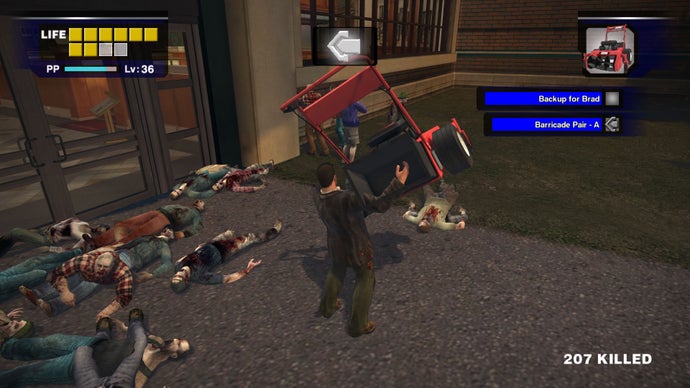
Dead Rising, released in 2006 by Capcom, introduces an open-world structure that encourages exploration and unorthodox gameplay while adhering to a strict time limit. Beyond the initial shock of witnessing horror—such as people feasting on each other by a school bus—players navigate a mall teeming with zombies and eccentric characters, from an enigmatic long-haired man to survivors needing rescue. The game provides a unique blend of storytelling and free-form gameplay, allowing players to choose their own paths.
### The Freedom to Explore
Unlike many contemporary open-world games that constrain player actions within a rigid narrative framework, Dead Rising offers an impressively pliable structure. Players may opt to engage in missions that unravel the game’s central mystery, seek out psychopath bosses, or even simply indulge in whimsical activities like fashioning makeshift weapons and experimenting with the environment. There’s a liberating feeling in the unpredictability of gameplay—players can dedicate time to combat, survival, or even leisurely observation of the bizarre happenings within the mall.
The game unfolds within a densely packed environment filled with layers of interactivity and detail. The shopping mall becomes a playground, contrasting the typical formula of vast, empty worlds. Items are logically distributed throughout the stores, adhering to conventions that make intuitive sense—you’ll find melee weapons in sporting goods stores, snacks in the food court, and outrageous costumes in the children’s area.
### Time: The Unyielding Force
A hallmark of Dead Rising is its real-time clock, which imposes a significant layer of pressure on players. Unlike many other games that freeze time until players take action, Dead Rising allows time to tick away relentlessly, lending a palpable urgency to every decision. The passing of time influences everything from zombie behavior to the appearance of survivors and bosses, creating a sense of authenticity that mirrors real life.
Players quickly adapt to this time-sensitive nature, reminiscent of Bill Murray’s character in *Groundhog Day*. Each playthrough becomes a cycle of anticipation, where prior experience informs future decisions. This cyclical gameplay mechanic reinforces a palpable sense of agency and responsibility, where missed opportunities can lead to dire consequences. Many cases simply expire, leaving players with the weight of their choices as they navigate through their three-day in-game timeline.
### The Narrative Landscape
Character interactions enhance this dynamic interactivity. With 54 survivors to discover, players can choose whom to help and how much to engage with each narrative thread. Each character is imbued with a backstory, like Cheryl, who pleads for a photograph to stave off her fears of being forgotten. These details elevate what could otherwise be stock figures into memorable, unique experiences.
The game, however, is not merely a playground of destruction and mild chaos; it also comments on consumer culture and societal behavior, as the backdrop of a shopping mall becomes a platform for social commentary. The juxtaposition of mindless consumption against a backdrop of survival horror serves to amplify the game’s thematic resonance.
### The Challenge of Survival
Dead Rising escalates its challenges as players grow more adept. Unlike many games where the world becomes easier as players gain better weapons and skills, Dead Rising’s difficulty ramps up in tandem with player evolution. Nighttime brings tangibly more aggressive zombies, and human antagonists add an unpredictable twist to the gameplay, ensuring that the thrill of challenge remains constant.
The tension between attempting to save survivors and completing case missions evokes a genuine sense of urgency. As players cycle through playthroughs, strategies evolve, granting deeper insights into gameplay mechanics and enemy behavior.
### The Evolution of Open Worlds
Despite its critical acclaim, the innovative structure of Dead Rising has yet to be fully replicated in subsequent generations of games. Most modern open-world titles still lean towards environments where time passes only when players engage actively. While some games, like *Persona* and *Outer Wilds*, have explored cyclical time mechanics and narrative-driven time constraints, the rarity of truly dynamic open worlds—where the passage of time is independent of player actions—remains.
In this context, Dead Rising stands as an outlier, an inception point for discussions about time, agency, and player experience in open-world gaming. Each new playthrough invites players to engage in fresh narratives and challenges while reinforcing the abiding tension of limited time and consequence, encapsulating both the brilliance of its design and the missed opportunities for future innovations in the genre.