**Delving into *King’s Field: The Ancient City*: A Nostalgic Voyage into FromSoftware’s Origins**
Recently, I devoted around ten hours to immersing myself in *King’s Field: The Ancient City*, the fourth entry in a series by FromSoftware. While the studio is now widely celebrated for its recent hits like *Dark Souls* and *Elden Ring*, *King’s Field 4* offers a captivating viewpoint on the ideas that have eventually influenced the *Souls* franchise.
Initially, *King’s Field 4* can prove to be a challenging endeavor, which isn’t surprising given its lineage from developers famed for their punishing difficulty. Released on the PlayStation 2, the game can feel awkward when juxtaposed with today’s titles that feature enhanced camera controls and accurate hit detection. My playthrough was a mix of irritation and enjoyment, with some moments captured in my review for Warp Week 2002. Nonetheless, various thoughts emerged during my gameplay that seemed too bizarre or random to include in the review.
For anyone who hasn’t encountered *King’s Field 4*, think of it as a precursor to the *Souls* titles you might be familiar with. The atmospheric essence remains vivid, imbued with eerie stories and a darkly immersive realm.
The game kicks off with an impressive intro that evokes nostalgia, particularly through a stellar guitar riff that highlights the grim undertones present. From the onset, the ominous warning about “grave misfortune” sets the atmosphere, prompting the consideration that perhaps steering clear of “The Idol That Stares Into the Darkness” is wise, though you could argue that such declarations have become a hallmark of the genre.
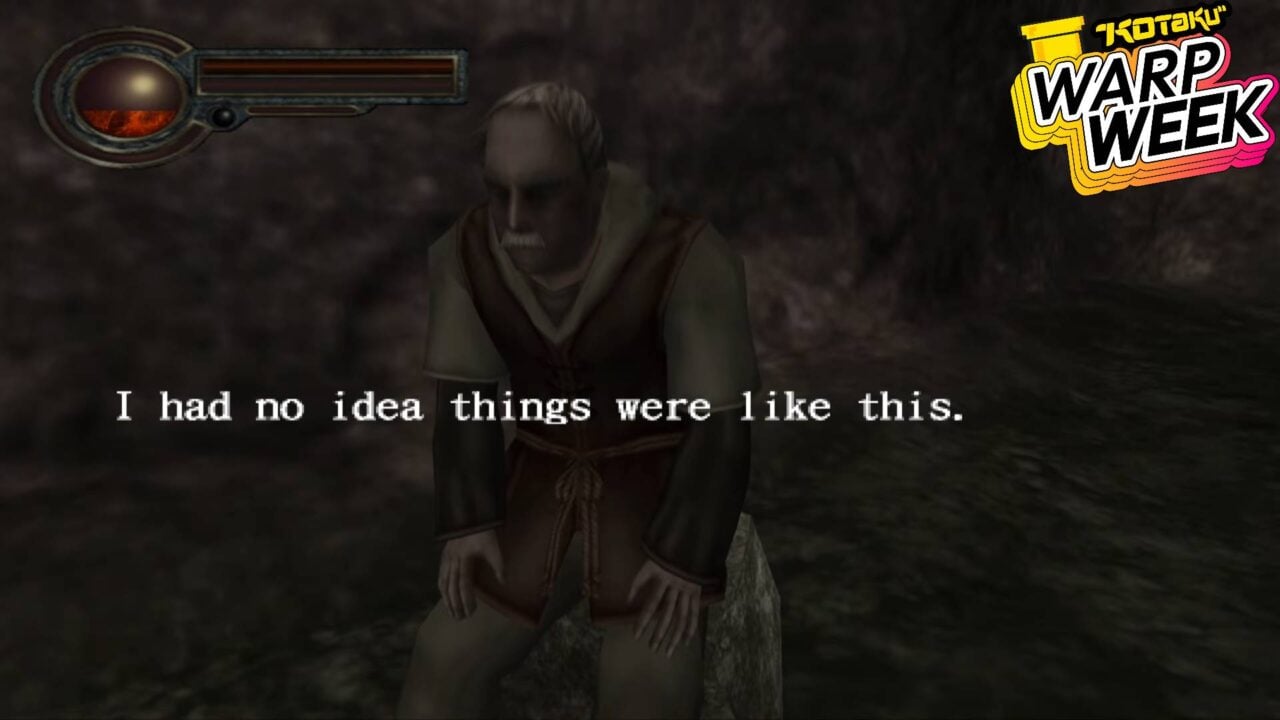
Upon embarking on my adventure, I was swiftly engulfed in the trials of navigation. The cumbersome controls served as a stark reminder of gaming mechanics from yesteryear, with my first attempts to move and scan the surroundings leading to a quick death—ironically, at the hands of the very ground beneath me. As I explored the game’s environments, I encountered a merchant named David Bunch, whose sorrowful demeanor resonated with the well-known trope of the “Sad Dark Souls Man” found throughout the series. His background and hesitance to venture into the cursed landscapes echoed familiar lore conventions, enriching the character tapestry of this universe.
Equipping weaponry turned out to be more complicated than I expected, requiring a series of aggravating discoveries and online inquiries, thus showcasing some of the less user-friendly design elements. The tantalizing idea of collecting in-game treasures often took a backseat as I struggled to comprehend the mechanics.
Much like its successors, *King’s Field 4* delights in its secrets and formidable foes, leading to numerous moments of bewilderment. Hidden environmental dangers resulted in unforeseen fatalities, and interactions with items frequently left me perplexed. At one juncture, I conversed with a character in search of a “Rock of Life,” humorously pondering the practicality of such an object in an already troubled environment.
Perils lurked at every turn, including early poison mechanics that undoubtedly reflected the studio’s inclination towards torment. Initially presenting a false sense of safety, my enthusiasm swiftly diminished as I depleted a healing spring, complicating my efforts to survive against incessant poison damage.
As I continued my exploration, I came across a swamp filled with poison and obstacles. The physical navigation of this area proved particularly taxing due to the unyielding camera controls and sluggish movements typical of PS2 games. Hours spent traversing this noxious terrain pushed me to my limits, culminating in a stubborn acceptance of defeat.
Nevertheless, after conquering the initial hostility of the poison swamp, I began to appreciate the game on a deeper level. By that point, I transitioned from annoyance to genuine engagement with the surrounding world, which ultimately led to a richer gameplay experience.
In conclusion, while my journey through *King’s Field: The Ancient City* was rife with challenges and moments of disenchantment, it ultimately represented a revisit to a classic that has significantly influenced the genre. The game’s fusion of atmospheric storytelling, haunting visuals, and relentless difficulty serves as a testament to the foundations of FromSoftware, paving the way for the memorable experiences we hold dear today in the *Souls* series.