### The Interplay of Industry and Landscape in Sandustry: A Reflection on Post-Industrial Wales
Before we explore the depths of **Sandustry**, the captivating new factory simulator from Lantto Games and Hooded Horse, it’s essential to draw a connection to the post-industrial countryside of Wales. Recently, I embarked on a 105-mile journey through this region, navigating old slate quarries near Aberllefenni, which held the distinction of being the longest continuously operated slate mining site until its closure in 2003.
As I traversed the remnants of this once-thriving industry, I encountered overgrown cottages and immense spoil heaps—massive mounds of broken slate that embody centuries of human labor. Visualizing the laborers tipping their wheelbarrows, I was struck by the immense scale of these heaps, a stark reminder of the impact of industrialization on both the landscape and the community that once thrived there. The sight felt like staring into a photograph of a landslide, weighing me down with the reality of industrial waste that, over time, becomes part of the ‘natural’ landscape.
The tragic Aberfan disaster of 1966, where coal heaps collapsed, illustrates the dangers of these industrial byproducts. This historical context resonates with the themes found in **Sandustry**, where a similar sense of dread intertwines with the mechanics of factory production.
In **Sandustry**, players assume the role of an alien prospector on a quest to transform sand into gold on a planet rich with buried ruins. Unlike other factory-building games like **Satisfactory**, which incorporate survival elements and enemy encounters, **Sandustry** allows players to glide freely through their creations, focusing on the interaction with the materials they’ve unearthed.
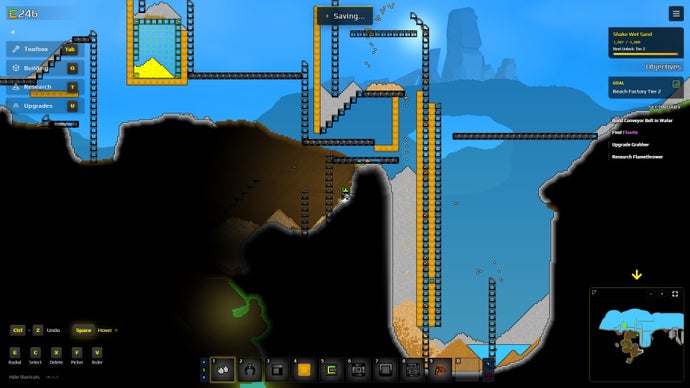
The game introduces challenges in the form of physics-driven materials that break down into individual pixels, creating a dynamic and engaging environment. The initial phase of production involves setting up conveyors and automated sifting trays to extract gold from sand, all while managing the byproducts that accumulate in the process.
What sets **Sandustry** apart from other factory simulators is its acute representation of industrial waste. Unlike the sterile and organized representations of excess seen in many games, **Sandustry** makes the heaps of byproducts a visually striking feature. Each discarded layer forms peculiar landscapes reminiscent of the spoil heaps surrounding Aberllefenni, evoking a sense of both awe and apprehension.
As players delve into their industrial landscape, they will discover that the accumulation of waste holds its own narrative. The colorful layers of debris indicate the processes and forces that shaped them, prompting reflection on the efficiency and design of factory layouts. This representation elevates the gameplay experience, enhancing the emotional connection to the landscape of production.
Despite the utilitarian aesthetic of **Sandustry**, there’s an inherent beauty in the chaos of its refuse piles. The game encourages players to reconsider their definitions of waste, as discarded material can eventually be repurposed for new uses, revealing layers of economic potential. This mechanic mirrors real-life scenarios where industrial byproducts can be transformed into valuable materials, much like how slate can be recycled into garden mulch or drainage solutions.
As players progress, they unlock new technologies converting sand residue into valuable resources, compelling them to revisit and manage their previously neglected heaps of materials. This process of discovery underscores the importance of sustainability and repurposing in industrial settings.
While my journey through **Sandustry** is still in its early stages, I sense that the game’s mechanics hint at a deeper commentary on our relationship with production and waste. The game’s premise, rooted in the insatiable desire to transform materials into gold, is not merely a tale of rampant capitalism; it illustrates a more profound desperation to utilize resources without the burden of waste.
In conclusion, **Sandustry** does not simply serve as a game about factory management; it reflects the intricate relationship between industrialization and the landscapes that bear its scars. Through its unique approach to waste, both in-game and within real-world contexts drawn from the post-industrial landscape of Wales, **Sandustry** invites players to engage with the complexities of production, refuse, and the enduring impact of human endeavor on the world around us.