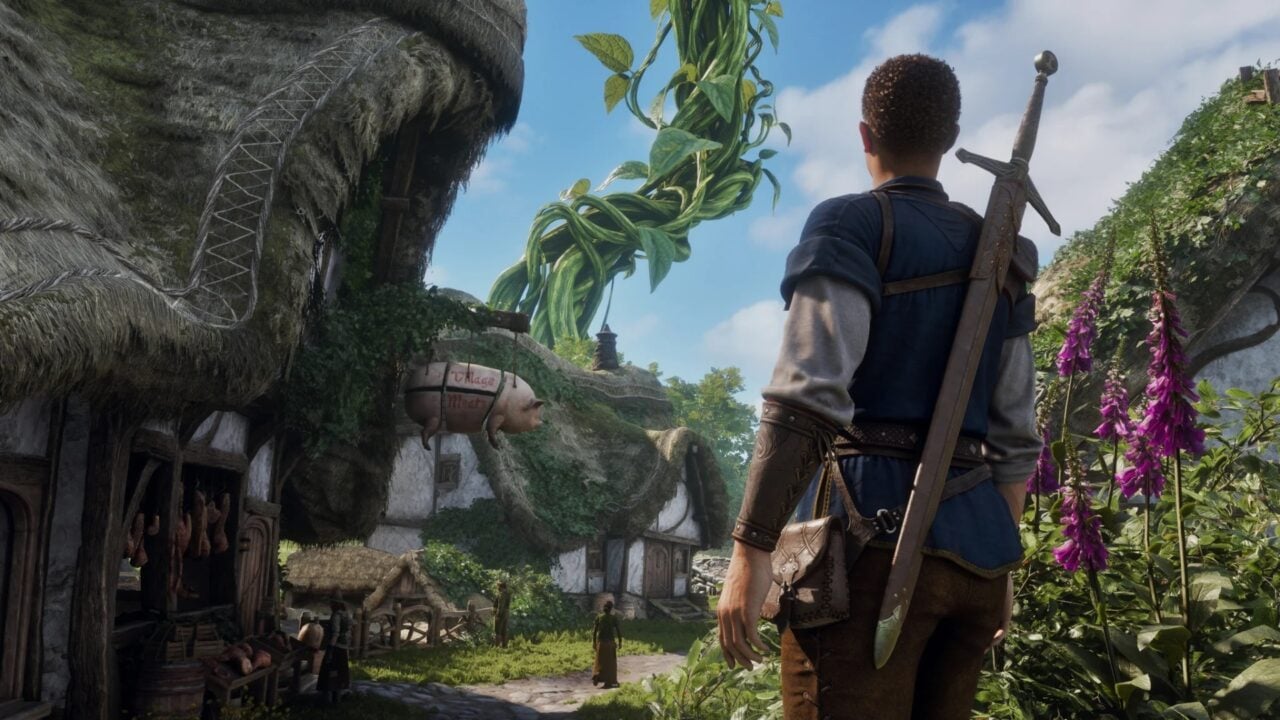
Fable’s battle system has ignited a wave of debate after gameplay clips released by Playground Games depict it as, frankly, lackluster. Around the 15-minute mark, the player engages with a hulking giant that appears to absorb continuous hits with minimal response. Yet, that footage fails to capture the complete picture. Having participated in a full, combat-intensive quest myself, I can confidently assert that the fighting experience is much more enjoyable than suggested by that one, misleading clip.
The quest is titled “Mud and Death,” occurring about halfway through the game. By this stage, players have a wide array of weapons available, including a sword, a bow, and a warhammer, along with a variety of magical abilities such as fireballs, lightning, and levitation. All of these tools can be used in diverse ways to reduce numerous skeletons to trembling heaps of bones.
In this quest, we are accompanied by an AI partner, Humphrey, voiced by Matt King, the faded leader of the Hero’s Guild, who guides us into a haunted mine filled with supernatural dangers. These creatures serve as perfect targets for experimentation. During the quest, I elevated foes into the air, conjured phantom daggers to target stragglers, sent enemies flying with force, and called down lightning to inflict chain damage on clusters of them. While the previously discussed gameplay footage appeared unresponsive, this served as a stark contrast.
“The dismemberment, especially, is fantastic,” states Will Kennedy, associate game director at Playground Games. “It’s excellent for showcasing the precision shots you can execute with the bow; shoot them in the head and they become headless, then launch them into the air because they can’t see you. Shoot them in the legs to topple them over, and they continue crawling toward you, which sets them up for ground kills.”
Numerous combo possibilities await. I utilized the teleportation spell to materialize behind foes near ledges, then sent them plummeting into the abyss. Others I levitated, taking advantage of the reprieve to charge up and unleash a fireball, resulting in a spectacular explosion.
Not only did I experience being a spellcaster, capable of slashing foes and summoning magic, but I also attempted the next playthrough as a bow master, rapidly firing arrows with machine-gun efficiency. It emphasizes the damage system—dealing more harm based on the hit location. “Some of them have randomized armor parts,” explains Kennedy, “meaning that ranged attacks won’t affect those enemies, but the areas exposed to ranged attacks will. If you have the skill and the vision to recognize that, you can exploit it. Blasting through them and dismembering them with the hammer is incredibly satisfying.”
However, it wasn’t just skeletons I contended with. They turned out to be possessed by wraiths, introducing their own set of challenges. Each time I downed a skeleton, I then had to chase and eliminate the pale green spirit that fled its former host in search of a new one. In these situations, using projectiles from a distance is advisable before it settles into its next skeletal vessel.
The quest’s ultimate challenge is the most daunting. Venturing out of the cave and into a misty swamp, we confronted a boss: the Lantern Keeper. It’s a colossal apparition bearing the sharply angled head of a 19th-century street lamp. After evading its fiery breath, I bombarded that head with arrows, landing hits with gratifying impact.
This variety in combat is the reason the developers chose to highlight this particular quest. “We aimed to select something that would provide one of the finest experiences possible when you first pick up the controller,” remarks Kennedy. “One aspect you can observe is the ability to have different loadouts, which yields varied experiences. You also get a glimpse of the power you can accumulate throughout the game.”
Nonetheless, it was a peculiar decision. This mission is an atypical instance-based one, so once completed, you cannot revisit it. “There are particular locations in the game that you traverse on a linear path that can only be experienced once, but we ensure there aren’t any features or content you might miss that you won’t be able to access later.”
I would have preferred an open mission that allowed for more freedom in that incredibly intricate world. After all, Fable is a vast fantasy RPG featuring a sizable fairytale sandbox ideal for exploration. This demo didn’t provide that. It was a straightforward trajectory through a shadowy cave faced with a barrage of foes. It lacked the game’s hallmark moral dilemmas or delightful NPC interactions. Yet, this may have been a clever choice. In concentrating on the