# Nighthawks Review
**Developer:** The Curiosity Engine
**Publisher:** Wadjet Eye Games
**Release Date:** September 22, 2026
**Platform:** Windows
**Availability:** [Steam](https://store.steampowered.com/app/1221950/Nighthawks/)
**Price:** TBA
**Reviewed on:** AMD Ryzen 9 7950X, 32GB RAM, Nvidia RTX 4070 Ti SUPER, Windows 10
Nighthawks, inspired by Edward Hopper’s iconic 1942 painting that captures the essence of loneliness and connection, delivers a narrative-heavy experience in the realm of RPGs. At its core, the game explores themes of isolation juxtaposed with connection, often resonating deeply when executed well. However, despite moments of brilliance, the entirety of the experience feels disjointed.
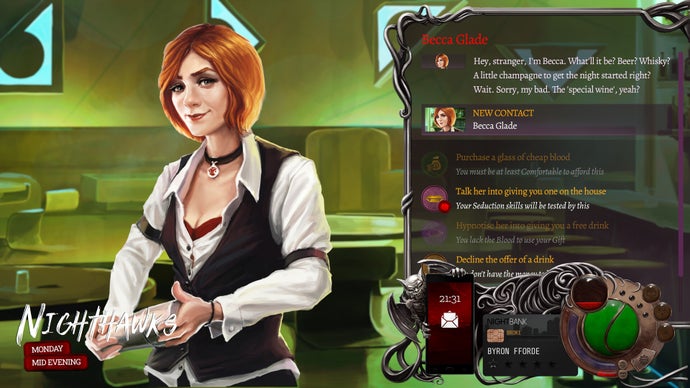
Set in a world where vampires have recently revealed themselves, players assume the role of a fledgling vampire who ascends to prominence in the city by taking control of the Nighthawks nightclub. The urban landscape consists of three distinct neighborhoods: the impoverished Cradlebridge, the vibrant Angelbreach red-light district, and the affluent Fountaincourt area. Players can delve into numerous mini-narratives by utilizing levelable traits such as brawling and seduction, alongside unique skills that add depth to interactions.
The narrative is central to Nighthawks, where the game’s visuals and sound design provide an atmospheric backdrop but do not overshadow the storytelling. The portrayal of city life is enriched with vivid details that evoke a strong sense of place, even as gameplay elements such as reused character portraits and repetitive music can detract from the experience.
The game’s structure is segmented into five acts, each presenting a series of vignettes that tell individual stories. Among these, standout quests involving the liberation of women from societal constraints emerge as the most compelling. These narratives adeptly weave together themes of oppression with the game’s setting, offering unique perspectives on both ancient and modern struggles. However, the overarching anti-vampire sentiment lacks the same depth, and the player’s growing power undercuts the urgency of these threats.
While the heart of the narrative shines in select moments, the pacing issues become evident as players navigate the first act, which struggles to engage through its reliance on underdeveloped secondary characters. A lack of clear motivation for companions further dulls early intrigue. This pattern of disengagement persists throughout the game, as players are afforded ample time to complete quests, resulting in a loss of tension and meaningful choice.
The RPG mechanics also fall prey to a lack of challenge; players are unlikely to encounter significant restrictions based on skills, creating a scenario where character development feels moot. The ease of maxing out abilities diminishes the impact of gear and companions, ultimately failing to reward strategic gameplay.
In summary, while Nighthawks boasts beautifully crafted moments reminiscent of Hopper’s masterful depiction of connection amidst solitude, the overall execution leaves the narrative feeling fragmented. There are fleeting instances when players can feel the emotional weight of the story, yet such moments are often overshadowed by uneven pacing and a lack of coherent structure. The allure of interesting subplots cannot fully redeem a game that, much like an unfinished sketch, yearns for greater cohesion and focus.
### Conclusion
Nighthawks stands as a testament to what a narrative-driven RPG can aspire to be, although it ultimately falters in fully realizing its potential. With a mix of remarkable storytelling and missed opportunities, it evokes a bittersweet sentiment that lingers long after the final act.