**The Intriguing Dynamics of Terra Invicta: Navigating a New Era of Strategy Gaming**
As the second alien fleet emerges at the fringes of our solar system two hours into a session of *Terra Invicta*, the game’s premise becomes apparent. While many players would be distracted by this extraterrestrial threat, others are knee-deep in the complex geopolitical landscape of Earth, vying for control over regions to secure resources and advance their strategies. *Terra Invicta*, which has transitioned out of early access, intertwines historical dynamics with the urgency of interstellar conflict, providing a unique gaming experience that challenges players to rewrite the fate of humanity.
The narrative of *Terra Invicta* pits players against a variety of factions, notably the Protectorate, an organization that embodies a pragmatic yet defeatist ideology. The Protectorate believes that humans cannot defeat the oncoming alien forces, arguing instead that subservience is the best course of action for survival. Playing as the Resistance against the backdrop of such beliefs invites players to embrace the role of a defiant strategist, akin to Gandalf standing against Sauron in *The Lord of the Rings*.
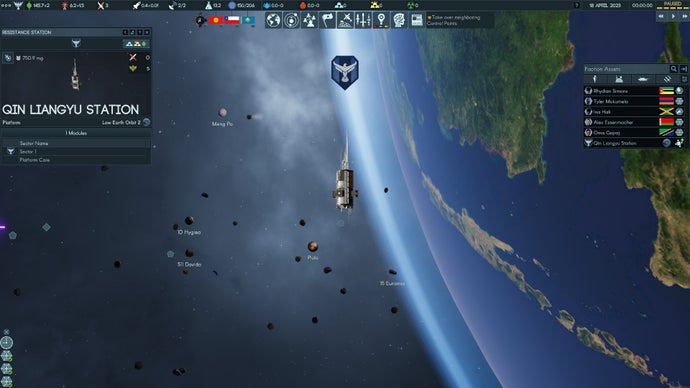
The journey to establish a secure presence in space begins with the construction of necessary infrastructure, like a space station in Earth’s orbit complete with solar panels and shipyards. However, to achieve these technological advancements, players must gain control over various countries—preferably those that are affluent, stable, and predisposed to scientific advancement. The game’s mechanics emphasize the struggle for influence in a global arena rife with rival factions, as players vie for control points that represent nations and their resources.
Set against a backdrop reflective of current geopolitical tensions, including the ongoing conflict in Ukraine, *Terra Invicta* captures the essence of real-world diplomacy and strategy. The game allows for a top-down view of Earth’s simulated societies while also tracking the trajectories of spaceborne resources, presenting a rich tapestry of narrative possibilities. As the simulation progresses, an array of notifications detailing events like research breakthroughs or environmental crises adds layers of complexity to the player’s decision-making.
The gameplay mechanics favor a blend of real-time simulation with pause capabilities, reminiscent of turn-based strategy games. Players are tasked with assigning missions to their councilors and strategically managing investments in controlled nations. While not as immediately daunting as other grand strategy titles, *Terra Invicta* presents its own challenges with a detailed interface filled with statistics and tables that players must navigate.
For those finding the game’s intricacies overwhelming, a simplified approach might be to liken it to *Risk*—a game of territorial conquest—while integrating the complexities of resource management and diplomacy. Success hinges on acquiring nations and ensuring their prosperity, ensuring your agents are well-supported and capable of executing your strategic vision.
With a player’s objective focused on securing advantageous positions, controlling neighboring nations can facilitate easier expansions. For instance, targeting East Africa or surrounding states offers leverage in the subsequent campaign for nations like Kazakhstan, rich in existing space infrastructure.
Despite moments of passive observation, the draw of *Terra Invicta* lies in its potential for emergent storytelling and excitement around future combat scenarios in space. Engaging with intricate ship designs and combat strategies promises to enrich the player experience as the game unfolds towards an unpredictable climax involving alien entities. Ultimately, as players navigate the complex interplay of terrestrial politics and cosmic threats, *Terra Invicta* embodies a fresh take on the strategy genre—challenging not just for its gameplay, but for the philosophical questions it raises about humanity’s place in an expanding universe.