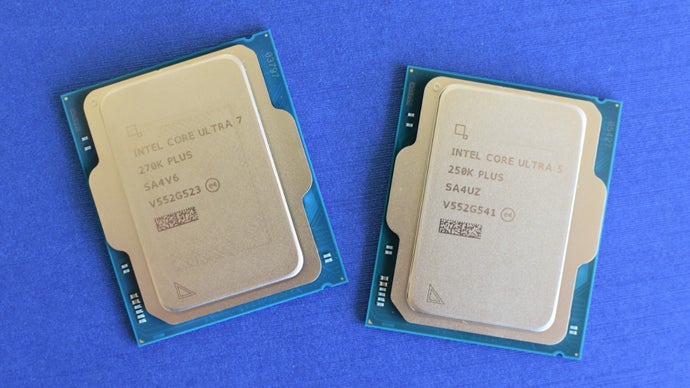
### Intel Core Ultra 7 270K Plus and Ultra 5 250K Plus Overview
The Intel Core Ultra 7 270K Plus and Ultra 5 250K Plus represent a significant effort from Intel to enhance performance in the desktop CPU market, particularly aimed at gamers and multithreading workloads. These processors are part of Intel’s Arrow Lake Refresh series, intended to rectify previous shortcomings in the Arrow Lake lineup. The Core Ultra 7 270K Plus is designed with 24 cores (8 P-cores and 16 E-cores), while the Ultra 5 250K Plus consists of 18 cores (6 P-cores and 12 E-cores).
#### Specifications
**Intel Core Ultra 7 270K Plus**:
– **Cores / Threads**: 24 (8 P-cores, 16 E-cores) / 24
– **Base Clock Speed**: 3.7GHz (P-cores), 3.2GHz (E-cores)
– **Max Turbo Boost Speed**: 5.5GHz (P-cores), 4.7GHz (E-cores)
– **Socket**: LGA 1851
– **Chipset**: Intel 800 series
– **Overclocking**: Unlocked
– **Max Turbo Power**: 250W
– **Price**: $300 / £TBA
**Intel Core Ultra 5 250K Plus**:
– **Cores / Threads**: 18 (6 P-cores, 12 E-cores) / 18
– **Base Clock Speed**: 4.2GHz (P-cores), 3.3GHz (E-cores)
– **Max Turbo Boost Speed**: 5.3GHz (P-cores), 4.6GHz (E-cores)
– **Socket**: LGA 1851
– **Chipset**: Intel 800 series
– **Overclocking**: Unlocked
– **Max Turbo Power**: 159W
– **Price**: $200 / £TBA
### Performance Analysis
The Core Ultra 7 270K Plus and Ultra 5 250K Plus have been aiming for a notable improvement in gaming and multitasking capabilities. They come with a base clock speed similar to previous generations but feature enhanced die-to-die (D2D) frequency to reduce latency from the split memory and compute controllers in previous models.
Despite these enhancements, benchmarks indicate that these processors do not necessarily outperform Intel’s previous 14th generation models nor do they effectively compete with AMD’s top-performing Ryzen chips. For instance, in gaming benchmarks, while the 270K Plus demonstrates a slight advantage in some titles, it considerably lags behind the AMD Ryzen 7 9800X3D in others.
### Gaming Benchmarks
In practical gaming tests, the Core Ultra 7 270K Plus out performs in specific scenarios such as “Cyberpunk 2077,” where slight optimizations have been noted, achieving a peak frame rate increase of around 4% when using the new Binary Optimization Tool. This tool is a part of Intel’s Application Optimization suite tailored to improve performance for older games.
However, both processors still falter in titles like “Total War: Warhammer III,” exemplifying their inefficient gaming performance compared to past generation Intel CPUs and AMD counterparts.
### Multitasking and Productivity
On a positive note, these CPUs excel in multitasking and productivity tasks. With a configuration that benefits heavily from multiple threads, both the 270K Plus and 250K Plus outclass their predecessors in benchmarks involving video editing, encoding, and complex computations. The additional E-cores significantly aid in performance for productivity-based workflows, making them better choices for users who prioritize these tasks over gaming.
### Thermal Efficiency and Pricing
Both models maintain cooler temperatures compared to the previous generation, making them suitable for builds with budget-friendly cooling solutions. The peak temperatures reported during stress tests were substantially lower than those observed in older models, which consistently struggled with heat management.
Moreover, at prices of $300 and $200 respectively, the Core Ultra series presents a cost-effective option in a landscape where high-performance components can be financially daunting. Their affordability, combined with improved thermal performance, adds appeal to budget-conscious builders looking for capable CPUs.
### Conclusion
While the Intel Core Ultra 7 270K Plus and Ultra 5 250K Plus mark a meaningful effort by Intel to enhance their offerings and correct past gaming performance deficiencies, they still struggle to fully compete against AMD’s latest technologies, particularly in gaming. For users focused on gaming, previous Intel generations and AMD’s offerings may still be more beneficial. However, these processors stand out as effective multitasking engines, particularly in productivity scenarios, making them a compelling option for users who require robust performance across diverse applications. As the CPU landscape continues