It seems that every week we’re reporting on news of another wave of layoffs at a big game studio. In March alone, we saw 1000 staff let go at Epic Games, 124 at Eidos Montreal, and over 100 at Ubisoft’s Red Storm Entertainment. And those are just the ones I can name without needing to rack my brain.
In some cases, these “reorganizations” are to keep investors happy; in others, they’re painted as necessary for a studio to keep the lights on until its next paycheck. But every time a team loses members, they lose something that can’t be replaced if the money ever begins to flow again. The shorthand and trust that develops between staff who work together for a long time, the institutional knowledge of what’s been tried in the past and worked (or didn’t), these only come from teams that remain intact.
Many have sung the praises of institutional knowledge and holding a team together before, but in the wake of layoffs like we’re seeing at the moment, it seems worth providing an example of why letting a team mature together makes for better games.
When I spoke to Greg Foertsch, founder of Bit Reactor and creative director on Star Wars Zero Company, it wasn’t to hear about his turn-based tactics spinoff of George Lucas’s sci-fi opera. I wanted to hear about XCOM 2, which celebrated its tenth anniversary in February. Foertsch was art director on both XCOM: Enemy Unknown and its sequel before moving onto Marvel’s Midnight Suns. An unexpected thread that ran through our conversation was what the strength that came from holding the creative team together.
Before working on Enemy Unknown, Foertsch was the art lead on 2006’s Sid Meier’s Railroads! If you compare the credits between the two games you can see just how many of the same names appear. “My team on XCOM was largely my team from Railroads,” Foertsch says. “So we already had some institutional knowledge and shared experiences and that made XCOM Enemy Unknown a little easier.” But the benefit of keeping the team together for nearly 15 years showed up in XCOM 2.
“Our goal was to keep the team together,” Foertsch states, illustrating the importance of retaining team members through the transition from Enemy Unknown to XCOM 2. Shortly after the successful launch of XCOM: Enemy Unknown in 2012, 2K Games approved the sequel’s development. Rather than downsize to a small pre-production group, the bulk of the team worked on a DLC expansion for Enemy Unknown while the leads began work on the sequel.
Foertsch noted that while both Enemy Unknown and XCOM 2 were built on Unreal Engine 3, the latter implemented new rendering technology, preventing asset reuse from the first game. However, this challenge was seen as an opportunity for the art team to showcase their newfound skills developed during the first game’s production.
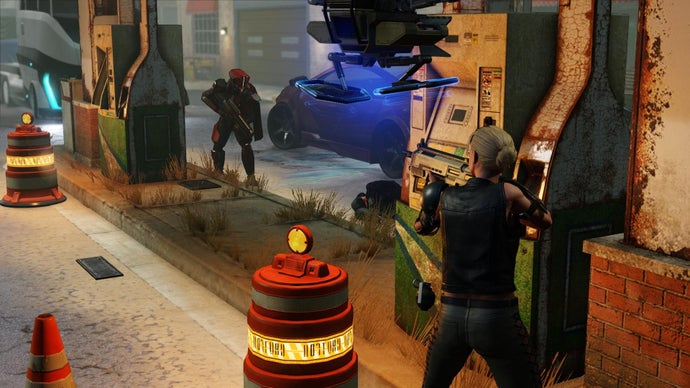
With XCOM 2, the team faced new challenges that allowed them to push creative boundaries further. Foertsch was confident in his team’s abilities to tackle these challenges head-on, leading to a larger evolution in character design. Notably, the differences in character classes and enemy functions prompted a comprehensive redesign of models to reflect these gameplay changes.
Foertsch described the improvement as “the difference between XCOM and XCOM 2 is like watching a team grow up right in front of your eyes,” emphasizing the growth that comes with teamwork and shared experience over multiple projects.
Despite the obvious strides in creativity and collaboration, XCOM 2’s development faced challenges. Foertsch characterized these hurdles as the team’s “teen years,” where creative decisions sometimes veered too far. A significant example was the team’s decision, mere months before release, to greatly expand the game’s cinematics. The prior experiences among team members cultivated through years of collaboration allowed them to navigate challenges effectively, reinforcing the value of a cohesive team.
In the years since Foertsch’s 2019 departure from Firaxis, the studio has faced its own rounds of layoffs, with the company citing “sharpening of focus” and “alignment of our talent against our highest priorities” as justifications for the cuts.
Reflecting on his time and the importance of team cohesion, Foertsch, who founded Bit Reactor in 2021, has surrounded himself with people from the XCOM series. This choice underscores his belief in the value of institutional knowledge and trust fostered by long-term collaboration.
Speaking to the industry at large, Foertsch remarked, “It’s so rare that we see teams stick together because institutional knowledge isn’t valued at all. Keeping teams together doesn’t seem to matter to people, but for us, it did.”
In the context of the current surge of layoffs across the gaming industry, his insights present a compelling argument for the lasting benefits of maintaining stable teams, highlighting that the true strength of a studio often lies in the rich, shared experiences of its members.