**The New Steam Controller Verdict: A Dual Perspective**
The resurgence of the Steam Controller has garnered mixed reactions since its initial debut. With its official release date set for May 4th, it has once again been the subject of discussion among gamers and reviewers alike. James and Julian, both seasoned gamers, recently shared their insights after extensively testing Valve’s latest gaming peripheral. Their discourse reveals contrasting views while highlighting the strengths and weaknesses of the controller in today’s gaming environment.
**The Controller’s Design and Feel**
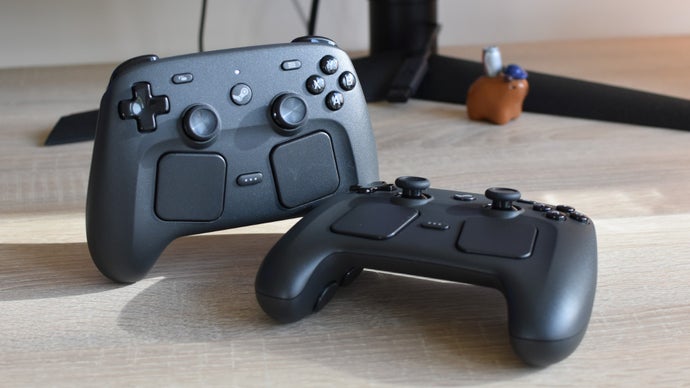
Julian kicked off the conversation by highlighting his fondness for the Steam Controller, rating it a solid eight out of ten for its magnetic thumbsticks. He noted that after transitioning from Xbox controllers, he found the Steam Controller surprisingly comfortable, despite initially perceiving it as bulky. The weight difference was minimal, with the Steam Controller being only 12 grams heavier, but it boasted an internal battery that surpassed his standard Xbox gamepads in longevity.
While James admitted to missing the ergonomic grips of his Razer Wolverine V3 Pro, he acknowledged that the Steam Controller excelled in functionality and price, being nearly half the cost. He appreciated its overall feel, emphasizing the quality of the thumbsticks, D-pad, and quieter buttons.
**Unique Features: Trackpads and Grip Sense**
Both reviewers appreciated the innovative trackpads that allow seamless navigation without the need for a mouse. This feature proved beneficial for playing games like Dota 2 and for managing various desktop tasks without interruption. Julian’s primary use of the controller was from his living room, allowing him to enjoy PC gaming on a larger screen effectively. The rumble feature of the controller enhanced his gaming experience, making it versatile for titles previously dismissed as unsuitable for consoles.
Julian specifically pointed out how the Steam Controller revived his interest in various complex games like Klei’s “Oxygen Not Included” by utilizing the Grip Sense technology. By remapping controls to these sensitive grips, he unlocked new ways to engage with previously challenging UI elements, transforming them into experiences that felt more at home on the couch.
James tested the gyro controls mainly in shooter games, finding it a bit challenging to adapt due to ingrained muscle memory. He lamented some accidental activations of the Grip Sense buttons but remained optimistic about discovering further usage for this innovative feature.
**Technical Performance and Compatibility**
When discussing technical interactions, both reviewers experienced some hiccups, mostly related to software rather than hardware malfunctions. Julian reported ease in pairing the controller with the Steam Link, basking in the nostalgia of Valve’s ecosystem and the seamless integration with older devices. However, he faced issues with text input in specific games and certain functionalities that faltered, such as the inability to navigate menus in “Half-Life 2” during critical moments.
James remarked on a unique vibration issue while playing “Silksong,” suggesting a potential firmware glitch. Despite their critiques, both acknowledged the importance of ongoing updates to improve compatibility with non-Steam launchers and to enhance functionality across various software environments.
**Future Considerations and Takeaways**
Julian speculated on the broader implications of the Steam Controller’s success for PC gaming standards, drawing parallels between it and the original Xbox controller’s influence. He expressed hope for future versions to incorporate additional features like a headphone jack for a more immersive experience without disturbing others.
As James concluded, the conversation reflected both optimism and caution regarding the controller’s long-term impact in the gaming community. They agreed to revisit their experiences once they had more time to explore its capabilities, hinting at the controller’s potential to redefine expectations for PC gamepads.
In summary, the Steam Controller has made a bold comeback, eliciting passionate discussions among users. Its innovative design and features have already begun to reshape the way PC gamers interact with their gaming experiences, setting the stage for continued evolution in gamepad technology.